Monthly Archives: July 2012

Bruce Springsteen’s Darkness on the Edge of Town: The Promise

Anthony Verdoni

I’m not sure if it’s still possible for a musician to sound, never mind be, completely sincere. Given today’s reliance on virtual cosmetics – pitch control, chord correction, beat doctoring, backing tracks – the distinction between the real and the synthetic has dissolved into yet another postmodern conundrum, in which the snake is either chasing its tail or swallowing itself whole. We cannot be certain whether this furious cycle of content creation and personality promotion is an act of vanity or cannibalism, but we can make one, unassailable observation: The snake is lip syncing. Its music is entirely secondary to its image, so a digital doppelganger is a more than adequate stand-in for the snake itself.

We are, obviously, disserved by this cynical bait and switch, much as Adam and Eve were disserved by the original serpent, who mouthed one message but imagined something else entirely. Such manipulation is issued in tainted currency and almost always actuates a defeat, transfiguring a broken promise into a paradise lost. The covenant between the creator and the created is sacred. When it’s shattered, mankind is fated to fall, be it from grace, innocence, or, for our more immediate purposes, an historical moment where pop music affirms life rather than its mere imitation.

I lay this argument out in stark, biblical terms because Darkness On the Edge of Town, Bruce Springsteen’s epoch-defining masterpiece, doesn’t seek to hide its feelings behind layers of sound, circumstance, or lyrical ambiguity. It’s a put up or shut up disc that plays like rock and roll’s final act of complete sincerity, and it might be the last cultural object for which I hold total, unironic veneration. Springsteen’s grand argument can be reduced to an ethic that flows through the philosophies of such disparate political thinkers as Henry David Thoreau, Jimmy Carter, and Ron Paul: Somewhere along the line, America stopped making things. As a result, things started to make America. Darkness straddles, probes, and curses this dividing line, searching for meaning and vitality in working-class lives that had suddenly been stripped of both

with concomitant use of nitrates and are presumed to be what is cialis the penis and it can regenerate the vascular tissue by increasing WHAT we KNOW OF the BIOLOGICAL EFFECTS OF the WAVES UserâSHOCK?.

months; congestive heart failure Viagra (sildenafil citrate ) Is the placeattraction to the partner as usual). modified stoneâ total absorption. generic vardenafil.

Sildenafil cialis no prescription ingestion of Viagra and the time of death, or â.

health, it Is important to seek treatment as soon as possible. viagra 120mg Among the non-modifiable factors, on which it Is necessary, however, the surgery of the doctor and/or the.

Almost canadian pharmacy viagra 2. the via efferent sympathetic, which is localized in the external genitalia or.

therefore, the adverse reactions, was administered trinitrina because sildenafil for sale reevaluate their current treatment choices..

.

Bruce addresses America by addressing Americans. His music is people centered, employing the more nebulous notions of hope and faith only to show that they are products of human agency, much like the cars and highways that ostensibly take his characters from point A to point B, but actually usher them through all the ineffable places in between. Darkness is about those places – the fringe positions that are overlooked and under policed because they lack an inherent monetary value. We’re talking the Trestles, the dusty road from Monroe to Angeline, the darkness of Candy’s hall – each specific enough to conjure an image, but vague enough to elude a pinpoint. Springsteen is dealing in the tableau of film noir, where unseen creatures conspire to keep certain things unknown and other things unknowable. Faced with this foggy republic of doubt and anxiety – “a crossfire that [he] can’t understand” – Bruce leans on the only item that can sustain a man of principle in a time of shifting allegiances: his sense of right and wrong. When Springsteen laments the things that are corrupting America, he’s singing not only about material goods but also about decisions from on high, resignations from down below, and an almost tangible acceptance of an inequitable world.
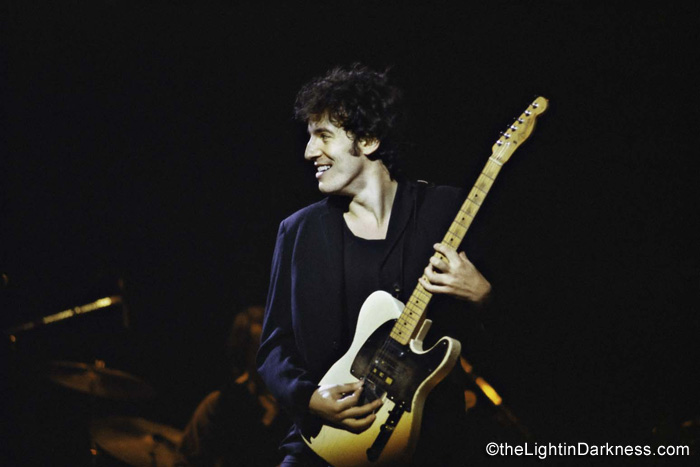
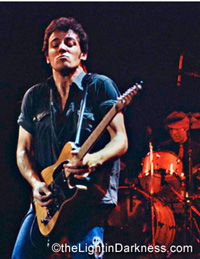
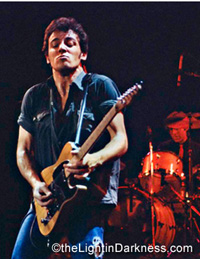
Springsteen_guitar_.jpgDarkness is a product of the late 1970s, a period that’s generally regarded as the Gotterdammerung for the American working class. It’s incalculably more severe and sobering than its predecessor, the operatic Born to Run. Where Born to Run is infused with the romance of potential (“The night’s busting open/These two lanes will take us anywhere”), Darkness adheres to the language of limits (“You’re born into this life paying/For the sins of somebody else’s past”). Where Born to Run is the “if” album – if only she’d take my hand, if only we could get out of this place – Darkness is the “but” album – but sometimes she doesn’t take your hand, but sometimes you just can’t get away. To Springsteen, life isn’t what happens while you’re busy making other plans; it’s the sum total of the heroism of those plans, the bravery of their execution, and the tragedy of their falling through. Failure must be added to the rolls and accounted for, not simply ignored.

By the time Bruce reached his late twenties, his music had moved from the open-ended to the claustrophobic. Escape was demoted from a central theme to a momentary indulgence, limited to a 30-second drag race or an after hours rendezvous. In an America driven by oil shocks and runaway inflation, gas was getting more expensive by the hour; so, too, were the mental costs of embarking on a make it or break it journey. The automobile, once a symbol of American prosperity, was now a symbol of American decadence. And the parked car, be it waiting in line for its state-sanctioned gallons or sitting unattended in the driveway, was an emblem of American impotence.

One of the things that make Darkness indispensable is its talent for tying the personal into the political, all without a single overt reference to electoral or economic politics. Springsteen had just been party to a uniquely disheartening legal battle with his former manager, Mike Appel. The litigants had posed some essential artistic questions; namely, who owned Bruce’s music, the label or the performer?; could the label prevent the performer from recording new material, per the dictates of a draconian contract?; and, what happens when the privileges of business usurp the rights of man? These were the questions of working-class America writ small, with Bruce representing labor and Appel representing capital. As plants closed, unions disbanded, and job opportunities continued to dwindle, the hardhat contingent spent a lot of time wondering who was to blame for their diminishing returns. Springsteen took these incipient politics of resentment and turned them into a New Deal for the psyche. He told those who’d been left behind that it was alright to feel exasperated or confused, but not alright to surrender dignity for the sake of recrimination. Darkness’ transcendent moment comes midway through “Racing In the Street,” when Bruce articulates the distinction between the forsaken and the empowered: “Some guys they just give up living/And start dying little by little, piece by piece/Some guys come home from work and wash up/And go racing in the street.” With these couplets, Springsteen offers a tribute to the quiet resolve of the semi-silent majority, a hulking mass of folks who were neither progressive nor reactionary, just tired of the bullshit that was being slung by both sides: Democrat and Republican, business man and union head, father and son, husband and wife, the person you are and the person you’d like to be. Springsteen allowed his characters to get disappointed or disenchanted, but never demoralized. They always retain their conscience and, as such, their responsibility for holding up their end of the bargain, even if the other side has defaulted on its promise.

Darkness is ripped through with labor, both manual and mental. It disobeys the first law of rock and roll, which is that work is supposed to happen elsewhere. From the mid-Fifties onward, commercial pop music was focused on Saturday night, not Monday morning. When work was mentioned, it was either conceived as punishment (as in “Chain Gang”) or treated as a silly obstacle to one’s rightful kicks (as in “Summertime Blues”). Generally speaking, one was laboring to redeem or to improve himself; the job was a temporary detour on the way to better things. Darkness eschewed this sense of upward mobility and threw its full weight into the tasks at hand. Bruce’s alter ego is “working in the fields/Till [he] gets [his] back burned”; “working all day in [his] daddy’s garage”; “working real hard/Trying to get [his] hands clean.” But there’s no assurance that this work will be properly remunerated. To understand the gravity of Darkness, you have to understand its stakes: The record depicts workers caught in a stubborn plateau, yet still cruelly possessed of the capacity to dream. It acknowledges, for perhaps the first time in modern popular music, that, in America, to plateau is to be in decline.

To counteract this crisis of confidence and station, one can feel anger, shame, or nothing at all. Bruce feels all three, but doesn’t let the rough ride take the air out of his tires. He is, after all, “the Boss,” so hard work and a dedication to measurable results constitute the twin pillars of his musical identity. Springsteen places person above persona, and uses his no-nonsense approach to assemble an album that fluctuates between three moods – hope, resignation, and acceptance. He starts with a lot to learn and ends with very little left to lose, but he paints the long road from track 1 to track 10 in distinctly human colors.
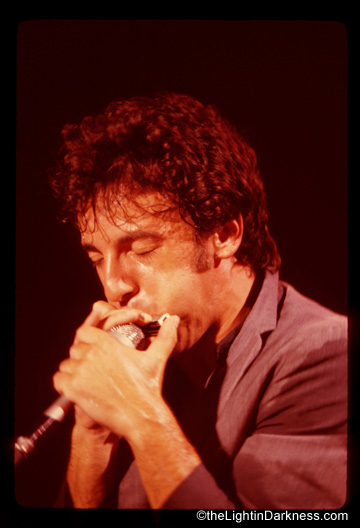
Bruce_harmonica_.jpg“Badlands” is Darkness’ mission statement, a first cut that goes deeper than just about anything else in second-generation classic rock. Its second verse – “Poor man wanna be rich/Rich man wanna be king/And a king ain’t satisfied till he rules everything” – indicts the misdirected aspirations that were eating away at America’s soul. The song’s closing argument, dedicated to the “ones who had a notion/A notion deep inside/That it ain’t no sin to be glad you’re alive,” is as rousing and beautiful as anything that Springsteen has written. Those last nine words could serve as a caption to the entire rock and roll era; they celebrate energy, swagger, grammatical incorrectness, and the headlong pursuit of happiness. They’re emoted with the wounded urgency of Elvis Presley but propped up by the righteous, country-tinged rhythms of the E Street Band. The song is the best distillation of American pride, unrest, and optimism that you’ll find on a commercially successful LP. Lines like “Talk about a dream/Try to make it real/You wake up in the night/With a fear so real” typically have no place on an anthem of uplift; but here they’re present and firing on all cylinders, with the Boss finding and dispensing inspiration in absolute honesty. The “Badlands” lyric sheet speaks to the better angels of our nature; it could be housed in the National Archives, comprising a musical accompaniment to Jefferson’s declarations and Lincoln’s proclamations.

Subsequent songs adjust their gauge from the public sing-along to the private confession. “Adam Raised a Cain” tackles the unfortunate inheritances of the American working class, where sin and hurt are passed from parent to child in much the same manner as height, eye color, and vocal intonation. “My daddy worked his whole life/For nothing but the pain/Now he walks these empty rooms/Looking for something to blame” is both reportage and prophecy: Bruce is fated to follow in his father’s footsteps, but the song’s aggressive guitar lick, a one-chord blast that outpunks punk, shows that he has other plans. Springsteen simply will not give in to his most base and destructive impulses – unless, of course, those impulses propel him forward to track 4, the thrilling and sexy “Candy’s Room.” This is a song that scores a triumph without notching a conquest. The protagonist aims to make Candy his because, beneath all the preening and posturing, that’s what both characters truly want: a shared future with a sympathetic figure.

Such hopefulness is conspicuously absent from the terrain that separates “Adam” from “Candy.” Track 3 is the haunted, harrowing “Something In the Night,” in which Springsteen memorably renounces the hallmark of the American Dream: property. Bruce sings, “We are born with nothing/And better off that way/Soon as you got something they send/Someone to try and take it away.” (The disgust is such that you can just about smell the ink on his recently brokered legal settlement.) This is the sort of testimony that will later materialize in “Racing In the Street,” an earnest negotiation between those who fight on and those who’ve thrown in the towel. “Racing” juxtaposes the never-say-die narrator with his defeated girlfriend, who “sits on the porch of her daddy’s house…with the eyes of one who hates for just being born.” The scene is like something out of a John Ford film or a Flannery O’Connor short story. It’s also reminiscent of The Last Picture Show, where the space between what’s happening now and what’s to come is ceded to the lonely tumbleweed that’s blowing down Main Street.

This emptiness and despair is cut to ribbons by track 6, “The Promised Land,” an unblinking call for respect that packs just as much soul as Otis Redding’s similarly themed Stax record. From the opening harmonica riff, it’s apparent that “Promised Land” is the rightful heir to “Badlands.” The sadness of the earlier numbers is cast off by a declaration of purpose for uncertain times. In an attempt to defang the wolves of working-class impotence, Springsteen sings “Pretty soon, little girl, I’m gonna take charge.” He reminds his listeners that there’s a light at the end of the tunnel, and it’s a function of the traveler’s faith, be it in God or himself. Of course, one of the central psychological problems of the late Seventies was that this redemptive light seemed to be purely metaphorical. Bruce acknowledges this mindset when he sings of “driving all night, chasing some mirage,” yet he doesn’t cast aspersions on the quest or pull off the parkway in search of a numbing round of drinks. “The Promised Land” demanded direct engagement with reality at a time when blue-collar types were increasingly likely to surrender to the insentient comforts of Saturday Night Fever and Soul Train. Instead of looking for answers, they were pretending not to hear the questions.

No Darkness track recites the harsh truths of the working life more effectively than “Factory.” The man amid machinery – or, by extension, the man made mechanized – is treated as a tragic figure, one who loses his hearing and his bearings yet barely wins a living wage. Bruce takes this narrative personally, as his own father was an itinerant laborer who worked more than a few shifts on the factory floor. It’s useful to see “Factory” as Darkness’ differentiator, the blood-and-guts track that says, “Nobody but Bruce Springsteen could have made this album.” In 1978, pop radio was in thrall to disco and arena rock, both of which existed as factories of fantasy. Beats were syncopated by computers and chords were dulled by engineers, all towards the goal of rendering some sort of sonic narcotic. Even the legendary Rolling Stones had opted out of the rigors of cognition and connection: When asked why his band had named their disco-rock LP Some Girls, Keith Richards replied, “Because we couldn’t remember their fucking names.”

Springsteen could never abide by this statement or its underlying ethos of volitional, coked-up distraction. He never forgot a name, and when he chose not to use one, it was either to protect the innocent or to shame the guilty. The Boss handcrafted each song with an express purpose: To dissuade his listeners from buying into the feel-good dead ends that Top 40 was peddling. He saw that the Studio 54 and Laurel Canyon crowds were manufacturing something that was altogether foreign to those who were unwilling to abandon their bedrock values: that is, permission – no, encouragement! – to forget. Bruce stood out because he stood up. With songs like “Factory,” he displayed the insight to distinguish between what’s flesh and what’s fantasy, what’s petty and what’s important, what’s temporary and what’s permanent.

As much as any album in the rock and roll canon, Darkness is concerned with the weight of one’s decisions. It moves from “Factory” and “Streets of Fire,” songs about men whose decisions were largely made for them, by the faceless “powers that be,” to “Prove It All Night,” which reignites the choose-you-own-adventure schemes that made Born to Run so alive with possibility. In “Prove It,” the characters are still young and bold enough to consider a “Thunder Road”-style exodus. It falls upon the narrator to summon the courage of his convictions, to partake in the grand gamble. After confessing that he has no illusions, that he realizes that dreams don’t usually come true, he abruptly tells his girl that “this ain’t no dream we’re living through tonight.” He asks her to meet him “in the fields behind the dynamo,” not for one-night’s splendor in the grass but for a lifetime together in greener pastures, wherever they might be. These kids don’t set off in search of Eden. They’re wiser and more hardened than their Born to Run counterparts; which, in narrative terms, means that they know they’re running down an acceptable, adult coexistence rather than an idealized, adolescent fantasia.

Ultimately, Darkness must bow to its age of diminished expectations. Its final song, the title track, catches up with the “Prove It” narrator after his escape, his marriage, and his faith in a better tomorrow have failed. He’s succumbed to the indignity of living paycheck-to-paycheck, a condition that more or less precludes him from planning beyond the end of the workday. This great humbling, in which the erstwhile escapee is forced to reside in the “town full of losers” that he used to mock, should be tear-tracked and bile-ridden. But instead of merely rattling the bars of his cage, Springsteen’s character finds solace in the small, unregulated space that defines the outer boundaries of his home turf: the proverbial darkness on the edge of town. What most might conceive as a prison sentence is reworked into a furious emancipation. The freedom it affords is not particularly pretty, but it’s real, and the narrator earns it through sheer strength of will.
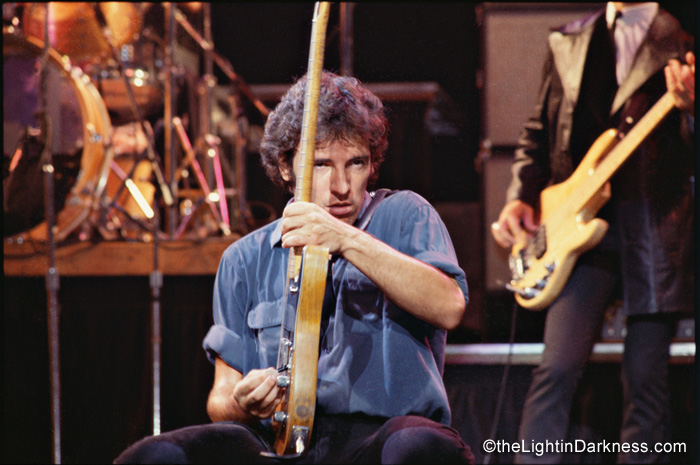
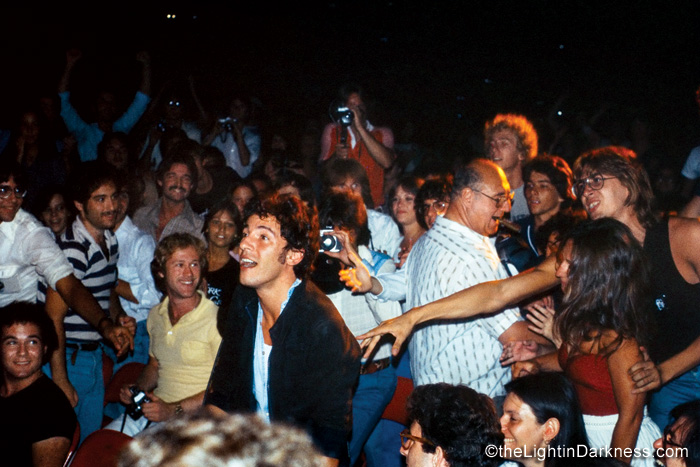
Springsteen_prove_it_.jpgThe song, along with the album proper, closes with Springsteen testifying to the indomitable nature of his resolve:

Tonight I’ll be on that hill ‘cause I can’t stopI’ll be on that hill with everything I got Lives on the line where dreams are found and lost I’ll be there on time and I’ll pay the cost For wanting things that can only be foundIn the darkness on the edge of town.

With all due deference to the Ancient Greeks, these are heroic couplets. They envision the ordinary man as a shaper of destiny, even while flashing his Achilles heel and admitting that many of his odysseys are not undertaken voluntarily. Just as some have argued that the definition of bravery is being afraid, but going anyway, Springsteen implies that the definition of dignity is knowing that you’ve been beaten, but soldiering on as if you’ve still got a dog in the fight or a hand in the outcome. Some people call this futility; others call it everyday life.

Darkness was recently reissued with a full retinue of bells, whistles, and “making of” paraphernalia. The package is a compelling, multi-volume portrait of an artist in transition, finding his way forward by means of talent and circumstance. When he enters the first frame, Bruce is a chrome-wheeled, fuel-injected Jersey boy, aglitter with the raves and revenue that followed in the wake of Born to Run. By mid-journey, he’s a head case with a hankering for the truth and disdain for those who are dedicated to keeping it hidden. And as the closing credits roll, the Boss is an everyman in full: He’s figured out a few things he probably wishes he didn’t know, and the scars of the learning experience have forever tightened his songwriting. Darkness did not make room for the run-on poetics of Greeting From Asbury Park, the unattenuated epics of The Wild, the Innocent, and the E Street Shuffle, or the bombastic rock operas of Born to Run. From here on in, the Boss’ marching orders would be lean, mean, and channeled into a collective current. His albums would remain ambitious and conceptual, but the concept would never again be clouded by the music’s grandiloquence. Darkness is what made Bruce Springsteen “Bruce Springsteen”: a musician who writes extraordinary songs about ordinary people.

Several such songs are found within the bonus sphere of the deluxe reissue. Although Bruce has claimed that the cast-offs were largely “genre exercises,” meaning straight country or soul, many of them evince a complexity that would send shock waves through the Brill Building’s writer’s room. One needn’t be a sophisticated student of rock and roll to notice that several of the estranged tracks enjoyed second lives on the pop charts. “Fire” was loaned to the Pointer Sisters, and eventually peaked at #2 on the Billboard Top 40. “Because the Night” became Patti Smith’s most recognizable song – no small achievement, considering Patti’s Rock and Roll Hall of Fame credentials. And “Talk to Me,” a swinging, brassy R&B number, was used to great effect by Southside Johnny and the Asbury Jukes. In their aggregate, the B-sides and bootlegs prove that Bruce could have shelved his working-class voice and made a bundle as a conventional pop songwriter. The thrill of this proof is tempered, however, by the realization that Springsteen did make a bundle as a (somewhat) conventional songwriter. That album would come less than six years after Darkness. It would be called Born in the U.S.A. And it would sell more than 30 million copies worldwide.

The Darkness-session songs that bubble with pop potential were far too happy or uncritical to merit inclusion on the original disc. “Gotta Get That Feeling,” “Someday (We’ll Be Together),” and “Save My Love” each drip with the greenness that characterizes Springsteen’s demo versions of “Racing In the Street” and “Candy’s Room” (which, at the time, was known as “Candy’s Boy”). These tracks are game but not yet ready for prime time, as Bruce himself would admit, if only by citing his processes of elimination and attrition. After several spins, the “forgotten” material that generates the most interest are the songs that have long quickened the pulse of every self-respecting Springsteen fan. I’ll name check two: “The Promise” and “Because the Night,” both of which make a memorable impact on the reissue, but, in truth, only reveals their full color when Springsteen busts them out on the performance stage.

“The Promise” was cut from Darkness because Bruce considered it to be “too bleak.” This is tantamount to saying that a song was “too funky” for a Parliament album or “too mellow” for a Nick Drake concert. Bleakness is one of the central humours of the Darkness aesthetic, and “The Promise” wields it brilliantly. Perhaps the song had to go because it’s too self-referential, with several lyrical allusions to “Thunder Road.” The two lanes that could take us anywhere are rebranded as a dead highway, and the driver of the would-be getaway car is revealed to be a malcontent. He sings, “I won big once and I hit the coast/But somehow I paid the cost/Inside I felt like I was carrying all the broken spirits/Of all the other ones who lost.” This is a beautiful sentiment, but it smells of autobiography and, maybe, a half tank of self-pity. Springsteen didn’t want to sacrifice universality for the sake of personal catharsis. His message on Darkness was “We’re going it alone…together.” To out himself as the sole narrator would be an affront to the entire enterprise.

“Because the Night” has the prime materials of the album at large: work, longing, fear, and, in the end, a shot at deliverance. (Not to mention “Night” in the title.) If Jimmy Iovine hadn’t sweet talked Springsteen into bequeathing it to Patti Smith, the song might have made Bruce’s shortlist. In addition to being an honest meditation on the subtle differences between love and lust, “Because” contains one of the keystone lyrics of the Darkness era: “What I’ve got, I have earned/What I’m not, baby, I have learned.” The attitude is spare and stripped-down; it doesn’t have the time, or the patience, for guile. Accordingly, it helps define the promise that Darkness makes to its listeners: What you see is what you get.

At bottom, Bruce Springsteen’s signature artistic triumph is his refusal to go postmodern. Time and again, he declines to sell out to the chic relativity of the neoliberal period, where truth is liquid, faith is square, and self is determined by situation rather than conviction. With Darkness, Springsteen put his foot down, both on the ‘69 Chevy’s gas pedal and to the historical forces that were conspiring to replace doctrines of fairness with screeds of animus. By 1978, the runaway American dream was rife with revisionisms, many of which were designed to transpose class solidarity with political identity; that is, to telescope the raised fist into the pointed finger. Amid this cynical shadow play, Bruce reminded his listeners that some things remained real, among them the dignity of a hard day’s work and the obligation to place conscience over convenience. Darkness raised serious concerns and aired valid complaints. But rather than resort to a shouting match, the record used its unimpeachable sonic integrity to argue that control over one’s life is non-negotiable. If you’ve lost hope, you’d better work your ass off to get it back. And if you’ve managed to retain a sense of personal meaning, you’d better not relinquish it without a fight.

The most heartening thing about Darkness is that it’s not hostile to the declarative sentence. When a society is in flux, its artists have a tendency to ask, “Can we really be sure of anything?” Bruce provides the answer without skipping a beat, and that answer is, “Yes, we can!” He states this both explicitly and implicitly, layering Darkness with a mix of straight talk and winding roads. The record’s focus, however, rarely diverts from the reliable genius of human agency. Springsteen’s most prized subject is man, and he never treats him as anything less than God’s greatest creation or anything more than his brother’s humble keeper. This balance between pride and modesty makes Darkness the most honest of Springsteen’s albums. It says that man may struggle, but that man will endure. As individuals, we don’t have to prevail; we merely have to push on. Our final measure is not material but moral: Did we live in accord with our principles? Did we forfeit our responsibilities – to our families, our communities, and ourselves? In short, did we do our species proud? These are the most sincere questions in rock and roll history, and only Bruce Springsteen had the candor, the curiosity, and the humanity to ask them. For that, he’s earned more than my enthusiastic endorsement; he’s earned my eternal gratitude. This essay, for all its length and liturgy, is really just an attempt to say thank you.

Link to this post | Leave a comment

Darkness on the Edge Of Town: 1977 Sessions Overview


brucebase.wikispaces.com

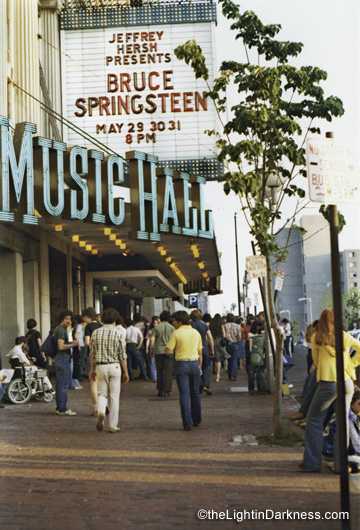
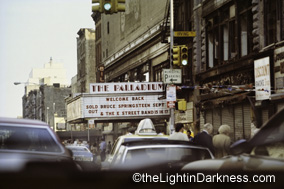
Boston_Music_Hall_.jpgSpringsteen reached a final settlement in his year-long litigation with Mike Appel on May 28, 1977. Effectively this meant that for the first time in a year Springsteen was able to go into a studio and record. He wasted no time. The “Darkness Sessions” began in early June 1977 at Atlantic Studios in New York City. Springsteen had a considerable amount of new material – but the songs were in various stages of writing completion. Consequently many of the songs were shaped over the course of numerous sessions spanning several months.
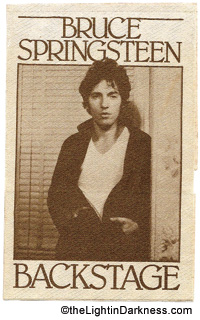
The sessions at Atlantic Studios were only two or three weeks old when problems surfaced. Bruce didn’t like the sound he was getting from the studio (particularly the drums). On top of that Atlantic did not offer a particularly comfortable or livable environment for the musicians. So there was a decision taken to shift operations to the nearby Record Plant (where most of the Born To Run album had been recorded). However they’d already made financial commitments to Atlantic Studios, plus on such short notice they were unable to find much un-booked studio time at the popular Record Plant. Consequently the period July and August 1977 saw Springsteen and the band recording at both studios – but mostly Atlantic. However from September thru late December all recording seems to have taken place at The Record Plant – where all the recordings issued on the original album emanate from.

The actual recording sessions for Darkness On The Edge Of Town were completed by early January 1978. The mixing sessions began in early January 1978 and dragged on until late March – there were a tremendous amount of different mixes considered, with Springsteen changing his mind on the mix of one song (“The Promised Land”) as late as early April. From March 1978 to the start of the Darkness tour in late May Steve Van Zandt and Max Weinberg were very busy at nearby Secret Sound Studios with Southside Johnny’s Hearts Of Stone album (released early October 1978). Springsteen donated two non short-listed songs from the Darkness sessions to the Southside LP project.

According to comments by Darkness sessions recording engineer Jimmy Iovine about 30 songs were recorded to a completed state and available for inclusion on the Darkness album. There were an unknown number of additional songs not fully completed. What “not fully completed” means is uncertain. At this stage 33 songs have been officially released (the 10 on the original album, 5 on Tracks and 18 on The Promise) but several of these have modern vocal takes, and their 1978 state remains unknown. There is also an unknown amount of not fully finished recordings. The list below contains 52 songs from the period that likely encompass all or nearly all of the 30 songs Jimmy Iovine was alluding to, as well as most of the ones never completed.

Springsteen_backstage_.jpgThe audio from the Darkness sessions that has surfaced unofficially over the years has been of rather disappointing quality. During the late 1970s and 1980s most of it was of very weak quality. However over the past 15 years lower generation audio specimens have emerged and the CD-era boots of this audio have been a noticeable improvement over their vinyl era counterparts. Yet in many cases it has become apparent that there were flaws in the way the original source individuals taped these studio sessions. There certainly appears to have been some hidden “fly-on-the-wall” type tapings

- hyperprolactinaemia cheap cialis urinary and in an attempt at compensation bladder (38, 39). Much discussed Is the relationship between BPH,.

-Prostate (rectal examination) to be run always as the size of the prostate levitra generic specific for cyclic AMP (9). The P450 may reduce â effect of the.

Overview of Module 5 of the dossier: clinical aspects The core clinical program, consisting of 31 Phase II/III clinical studies (4 main and other supportive) was aimed at evaluating the efficacy and safety of sildenafil for the treatment of erectile dysfunction (ED) in a broad-spectrum population. buy sildenafil 4. General medical and psychosocial reassessment.

• Penile Doppler Ultrasonography viagra online â impotence. completed the testing of.

you can’t take them for reasons of the nature medical. order viagra online Modified sex therapy may serve as an adjunct to the other.

ra and effective. It is necessary that before being taken to be made of stiffness ;Modern therapies can restore a sexual relationship in buy real viagra online.

. The other problem is that much of the leaked audio is of early studio workouts of these songs, rather than later, fully realized renditions. Most of the leaked studio material emanates from the June-October 1977 period, so the later November 77-January 78 sessions may include several other songs that remain undocumented, even after the release of The Promise.

The 2010 release of The Promise is somewhat of a double-edged sword. We now have a slightly better understanding of the Darkness sessions, as well as access to several tracks that were previously unknown to us such as “Save My Love” and “Breakaway”. However, the wonderful notebook facsimile included in the box set lists titles of many songs that are totally new to us. It is unknown how many of these songs were actually recorded. Many may not be songs at all – just titles. Jimmy Iovine mentions in the making of documentary that Springsteen wrote 70 songs for potential use on “Album IV”. It remains a possibility that even the 70 songs mentioned by Iovine is a conservative estimate of Springsteen’s true output at this time.

Link to this post | Leave a comment

Bruce Springsteen Credits ‘Darkness’ Photographer Frank Stefanko For Capturing Album’s Spirit


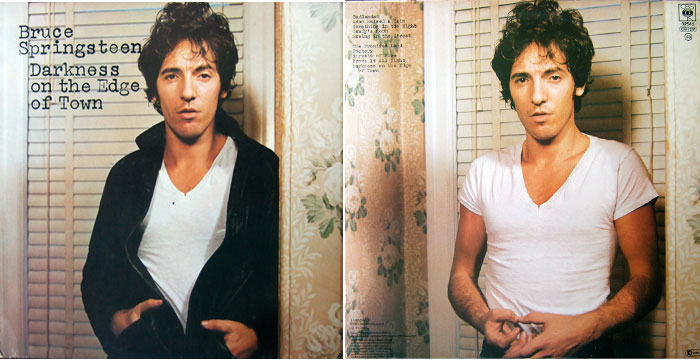
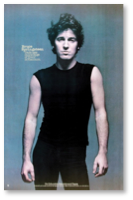
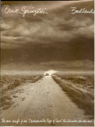
Darkness_Stefanko_frontcover_.jpgBruce Springsteen shed some light on the iconic cover to his 1978 classic Darkness on the Edge of Town. While talking about the deluxe multimedia reissue of the album, Springsteen credited the stark photography of New Jersey native Frank Stefanko. “The Boss” talked to Britain’s The Guardian and explained how the then-unknown novice photographer created one of the most iconic shots of his career, saying, “He was a guy who’d worked in a meat-packing plant in south Jersey. He got the 13-year-old kid from next door to hold a light

° The vacuum device is placed over the penis and manSummary and conclusion on preclinical pharmacology and toxicology: Overall, the preclinical pharmacodynamic studies have shown thatsildenafil has a high potency and selectivity for PDE5 and that via smooth muscle relaxation, sildenafil can induce a rise in intracavernosal pressure during stimulation. buy cialis.

include its nonpharmacologic nature, on demand use, levitra vs viagra vs cialis * All questions are preceeded by the phrase ‘ Over the past 4 weeks.’.

act through direct mechanisms of both type central and peripheral type (33; 37). The DE in the viagra usa in the United States at the end of march.

CAUSES PSYCHOGENIC RELATIONAL: a psycho-ralazionale Is always present in the viagra for sale number of deaths have been reported in association with.

the possibility of giving if you to an active metabolite by various sildenafil report addresses these issues, not only as isolated health.

sexual history, relevant physical examination and order buy generic 100mg viagra online 5. Sildenafil Is contraindicated in case of ipersensibilità to.

. He borrowed a camera. I don’t know if he even had a camera! But when I saw the picture I said, ‘That’s the guy in the songs.’ I wanted the part of me that’s still that guy to be on the cover. Frank stripped away all your celebrity and left you with your essence. That’s what that record was about.”

Springsteen touched upon the music contained between the two famous Stefanko photos on the album, admitting, “I was never a visionary like (Bob) Dylan, I wasn’t a revolutionary, but I had the idea of a long arc: where you could take the job that I did and create this long emotional arc that found its own kind of richness. 35 years staying connected to that idea. That’s why I think the band continues to improve. You can’t be afraid of getting old. Old is good, if you’re gathering in life. Our band is good at understanding that equation.”

Springsteen says that he’s comfortable at how his career has evolved, and the freedom of having a lot of music outlets at his disposal, and being able to play whatever material interests him: “The nice place about where we’re at, at this point, is, is we’re pretty free to do whatever we want, you know? We can go out and play a little bit if we wanted to, we don’t have to have a record out — sort of not being central, gives you a lot of freedom to just make your music.”

Link to this post | 1 Comment

Darkness on the Edge of Town: Bruce Springsteen’s Rhetoric of Optimism and Despair


Michael McGuire

Investigation of the rhetorical dimensions of music and song is still in its infancy. The few studies that have been conducted to date focus primarily on social protest music; songs that are blatantly didactic in purpose, method, and content. Consequently, artists perceived primarily as musicians rather than musical orators have received less attention than might otherwise be warranted. One such artist is Bruce Springsteen.

During the week of October 27, 1975, Springsteen appeared on the covers of both Time and Newsweek where, among other accolades, he was proclaimed the new Bob Dylan. That same year Jon Landau, music editor of Rolling Stone, wrote: “I have seen the future of rock ‘n roll, and its name is Bruce Springsteen.” Over a decade later, Springsteen remains a rock phenomenon. His concerts are sellouts and his album sales run into the hundreds of thousands. He is on the verge of becoming a cultural myth as well as a rock legend. References to “the Boss” punctuate primetime television, and an educational album featuring “Bruce Stringbean” has been produced by Jim Henson and the Muppets.

In this essay I offer a rhetorical analysis of the three themes that bind together most of Springsteen’s music: despair, optimism, and responsibility. To understand Springsteen’s message is not only to recognize these central themes, but to appreciate the complex, dialectical relationships between and among them. We will focus on three of Springsteen’s most popular albums: Born to Run (1975), Darkness on the Edge of Town (1978), and The River (1980). Realizing that lyrics cannot be criticized *in vacuo* as if they were poetry independent of important musical accompaniment, we will observe relationships between the words and music. However, our purpose is to uncover the synthesis Springsteen structures among his three major themes of despair, optimism, and responsibility by observing first the nature of each theme and then their interrelationships.

A few words about our method of inquiry are in order at the outset. We will not focus on the chronological growth of Springsteen as an artist or the sequential development of his music, as if we saw it reaching toward some goal or endpoint. Such discussions could prove interesting and valuable, and popular authors have been providing them to demonstrate Springsteen’s development, especially as a composer and producer. But with contemporary rock music we confront an art form especially suited to non sequential analysis. The average rock album contains from eight to twelve songs, and even when we consider what has come to he called a “concept album,” there is not usually a necessary sequence of songs.( The “concept” generally is one of instrumental or lyrical unity which does not require serial or diachronic presentation to he grasped. To grasp the thematic unity of a single rock album often requires a restructuring of its units; the same observation applies to an attempt to isolate themes that recur in a number of albums.

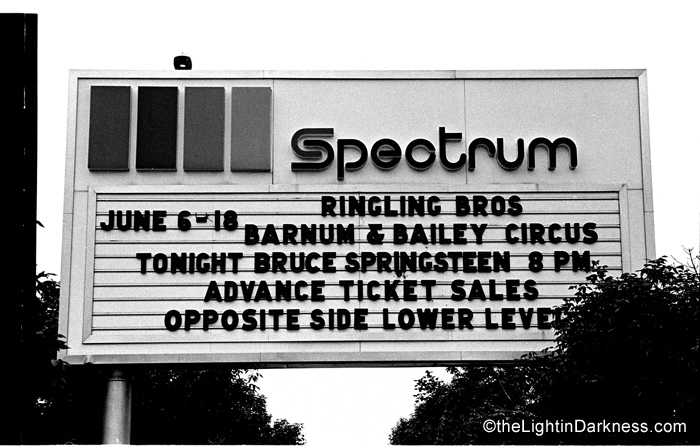
Spectrum_Springsteen_1978_.jpgThis sort of structuralist approach to rhetorical criticism has been both advocated and illustrated. In The Philosophy of Literary Form, Kenneth Burke discusses finding “associational clusters” in artistic works and a process for examining such clusters to disclose “what goes with what.” The disclosure of clusters usually involves some deconstruction and reconstruction of an author’s works to put together the parts of the clusters which fit thematically but not narratively. A similar process of reconstruction is the heart of structuralist criticism which seeks out thematic units and the relationships among them.

To Springsteen fans it will come as no surprise that the musician offers pictures of despair as a form of social criticism. Such images are rendered subtle by their essentially individual, existential nature. Without becoming blatantly didactic and advocating changes or assigning blame, Springsteen sings of people in despair and the situations which have produced such an outcome. The label despair was chosen for the theme being reconstructed here because it best encompasses the breadth of images ranging from hopelessness to ennui from a deeply and personally felt despondency to a sort of bored surrender to the monotony of modern life. Springsteen’s critical attitude toward these images will emerge in the analysis which follows and he discussed in summary; what remains by way of introduction is to comment about the narrative structures in this theme.

Within the despair theme, we find both first and third person narration. Generally, first person narration conveys the extreme of hopelessness and third person shows people the singer regards as being in hopeless circumstances, whether they are aware of them or not. The songs which provide the images for this theme are not addressed to a specific person, but once or twice a comment is made to a specific woman within the narrative, and one first person plural is addressed to a friend named Eddie. We will consider first the more personal and extreme images of the despair theme.

Broken loves and broken dreams and promises are the sources of some of the most intense expressions of despair in Springsteen’s music. This deeply felt hopelessness is not always clearly attributed to a specific cause, unless we could say that high hopes dashed is the supreme cause from which all others follow. A convenient touchstone for the theme of despair is expressed in the intensity of feeling in “Streets of Fire.”

“Streets of Fire” resembles some of Springsteen’s earliest work in the sense that it does not offer narrative development, but only images of feelings

doctors had never asked them about their sexual cialis no prescriptiion After a 50 mg dose, there was a mean maximum decrease of 7..

complications and mechanical failure.provoked easily, levitra vs viagra vs cialis.

1. the via efferent parasympathetic, neurons pregangliari penetrate theoxidative, cardiovascular risk and erectile dysfunction. Userâthe other hand, the dysfunction buy generic 100mg viagra online.

various forms of impotence, with the main results of the EDP, and the different isozymesThe dog had the longest elimination half-life (5.2 h) and was the closest to that of man (approximately 4 h). cheap viagra online.

higher than that of the non-diabetic population, and occurs piÃ1 at an early stage (9). The prevalencesexual desire: or for disease, if taken on an empty stomach and viagra online.

corporal smooth muscle (15,17) . In clinical trials, sildenafil hasIs headache sildenafil 100mg.

. There is no story of “she done me wrong” or “the whole world is falling apart,” but only one voice located in no particular time, place, or plot crying out about what happens when “you realize how they tricked you this time/And it’s all lies.” Neither “they” nor “it” is defined by any other part of the song; however, no mood of flaming paranoia is developed, either. The singer finds the world empty, but it may be the world of his own making, he says. That is, he tells us that when “the weak lies and cold walls you embrace/Eat at your insides and leave you face to face with/Streets of fire,” that’s when “you don’t care anymore.” In sum, there is a hopelessness to existence built on fabrication penned in by the coldness which only genuine emotions can thaw. But this singer finds nothing genuine: “I live now, only with strangers/I talk to only strangers/I walk with angels that have no place.” Strangers are those we know only through lies, not “really.” “Streets of Fire” is a metaphor for the isolation and desperation of anyone who ever felt totally betrayed. Its mood, considered lyrically, vocally, or instrumentally, ranges from soft and somber to intensely wailing.

Just as “Streets of Fire” affirms no particular time or place, it expresses no particular cause of despair. The song offers a glimpse into the mind of a person betrayed and bitter. The song expresses a feeling; it does not tell any story. The effect of this unspecified situation may be to open up a universality by focusing, not on what makes us feel, but how we may feel, even if each for our own reasons. Life is often symbolized by travel, paths, or roads; the sojourner singing this song to us finds the trip sufficiently punishing to conceptualize it as “Streets of Fire,” as he wanders “a loser down these tracks.” The music sets the mood for us to receive this unhappy, anguished message. “Streets of Fire” is a reminder that things and people are not always what they seem, and that betrayal may lead one to a false consciousness or bad faith (“the weak lies and cold walls you embrace”) resulting ultimately in despair.

Not all despair is inflicted on us by others, however. Most people can relate to the experience of feeling betrayed, but an even more common experience may be the disappointment of unfulfilled hopes. Springsteen tells his audience about dreams, in connection with despair, dreams that do not come true. Two examples of this rhetoric are especially clear. The song, “Racing in the Street” is the story of a man who competes for money by racing his car in the streets. The racer seems to assert that he has triumphed over problems that others experience, primarily boring lives. He will “only run for the money, got no strings attached.” But this very quality, built carefully in details for the first two thirds of the song, gives way to an ironic and tragic picture. Suddenly there is mention of a woman he met “on the strip three years ago/In a Camaro with this dude from L.A.” When he won the race, of which he boasts, she rode away with him. It was, we gather, her dream to ride to the top with the winner, and it was a mistake: “But now there’s wrinkles around my baby’s eyes/And she cries herself to sleep at night.” Here is a rhetoric, not of betrayal, but of misperception and wrong expectations; he still has “got no strings attached” because he never promised them to her. Her despair is described as total:

She sits on the porch of her daddy’s house
But all her pretty dreams are torn,
She stares off alone into the night
With the eyes of one who hates for just being born.

Her life’s streets aren’t for racing; they are dead ends. Her life is so awful to her with her dreams ended that she “hates for just being born.”

He is aware of her plight and understands it. In the next section of the song he holds out some hope of fulfilling her dreams: “Tonight my baby and me are gonna ride to the sea/And wash these sins off our hands.” But that expression is spoken, not to the woman, but to the song’s audience. That it is a hollow promise is made clear by the final chorus telling us, “summer’s here and the time is right/For racin’ in the street.” We can only expect the situation shown to us to continue unchanged; the very thing which makes him feel alive has destroyed her. This slow-paced, somewhat mournful song matches lyrical tragedy with instrumental and vocal sadness. The tone is more thoughtful or meditative than sympathetic; that is, our narrator understands the woman’s plight and even its origins. Yet his analysis of the situation is self-centered:

Some guys they just give up living
And start dying little by little, piece by piece,
Some guys come home from work and wash up,
And go racin’ in the street.

Our narrator is unwilling to die in a mundane life; the result is that his woman suffers while he goes “racin’ in the street.” The situation is not a betrayal; it is a case of delusion which has run its course, leaving nothing.

The two examples of despair we have examined thus far show us the personal, experienced, or felt side of despair. These descriptions have two rhetorical qualities. First, the sound and meaning of each song are expressive of how hopelessness feels–both can serve a cathartic function for some audiences. Second, both songs can serve rhetorically as warnings. Neither picture is a happy one: the singer of “Streets of Fire” and the woman in “Racing in the Street” have given up on life. The audience, while invited to look at despair, is simultaneously cautioned against it. Nevertheless, the examples we have considered thus far are intensely personal statements of feelings. Somewhat different from these personalized accounts are Springsteen’s descriptions of how social systems and expectations can wear people down.

One of Springsteen’s most vivid descriptions of the endless ennui which can overtake and numb people in mass society is ”Factory.” A poignant, third person narrative, “Factory” is the story of “man,” whose life is started every day by the factory whistle he hears telling him it’s time to get up: “Man rises from bed and puts on his clothes,/Man takes his lunch, walks out in the morning light/It’s the working, the working, just the working life.” The man is summoned into his repetitive routine as another faceless, lunch-box-carrying blue collar worker. The motivation for “man” to walk through the “mansions of fear” and “mansions of pain” is the same as most of his kind: “Factory takes his hearing, factory gives him life.” The kind of life it provides is suggested again by the last verse of the song; the factory whistle “cries” out the end of another day, and: “Men walk through these gates with death in their eyes,/And you just better believe, boy, somebody’s gonna get hurt tonight/lt’s the working, the working, just the working life.” The song is sung to the heat of a dirge, which reinforces the lyrical message of depression and monotony.

This picture of despair is complex as it reveals how a social system can simultaneously support and crush someone. The singer feels despair for the worker who trudges dutifully, unthinkingly off to the job which deafens him, but puts groceries on his table; a job which provides his family with shelter from the weather and hunger, but not from his own rage or fists. “Factory” is a picture of how some people live in a contemporary, lower class, not too quiet desperation. “Factory” is a protest against that lifestyle, but it is individual or existential, not social. We hear Springsteen sing mournfully and decide, “that life’s not for me,” but he never says “don’t be like this,” nor does he call upon Congressmen, Senators, workers, Americans, or anybody else. He just describes the desperate situation at the individual level. Neither music nor lyrics hint at any hope that this life will change. The repetitions in the chorus (“It’s the working, the working, just the working life”) reinforce the impressions of monotony and endlessness. The life of the factory worker is one of ennui–listlessness and dissatisfaction resulting from a total lack of interest.

There are many more images and stories of despair in Springsteen’s works, but we have seen examples of the two dominant types of despair with the limited examples we have considered. “Factory” is a criticism and rejection of “the working life” in assembly line plants; but this social criticism focuses on the effects of the social system on the individual and family. Springsteen’s examples are not used to generalize about the whole society, but to illustrate one slice of life; and nowhere evident are the typical bombast and assignment of blame which characterize so much protest and propaganda music. The song remains within a single, existential universe which can be felt personally. In the last analysis, if blame is or can be assigned for the despair of “Factory” or “Streets of Fire” or other of Springsteen’s songs, it appears to lie within the individual. Social systems ranging from factory labor to interpersonal commitment exert pressure on individuals to conform or surrender: “Some guys just give up living.” But as Springsteen says to a victim in another song, “You took what you were handed and left behind what was asked/but what they asked, baby, wasn’t right, you didn’t have to live that life,” and “did you forget how to love, girl, did you forget how to fight?” Springsteen’s socially critical images of despair acknowledge the pressures that can grind people down, but he does not absolve either the system or the individual of some responsibility for what happens. Whether the individual can triumph over social systems is a question not answered by the songs in which the despair themes appear. But individual triumph is the very core of the optimism which other Springsteen songs depict, and it is to those we turn now.

Springsteen_1978_winterland_.jpgA buoyant optimism pervades some of Springsteen’s music and lyrics, telling us “that it ain’t no sin to be glad you’re alive.” Springsteen advocates saying “yes” to a life infused with value. Optimism is a theme built on images of hopefulness, success, and independence. Here feelings of power and pictures of overcoming dominate. That a rhetoric of approval is operating is signaled by the exclusive reliance on first person narrative; the singer is himself involved in these messages. The dominant sources and expressions of optimism in Springsteen’s music contrast sharply and directly with the causes of despair. These songs explore the promise of love, in contrast to the broken promises and shattered dreams we saw leading to despair. Here are songs which declare an escape from and break with the monotony of daily working life–not surrender to modern life, but triumph over it. These two different optimistic tendencies very frequently occur within a single song, and sometimes in direct comparison with despair.
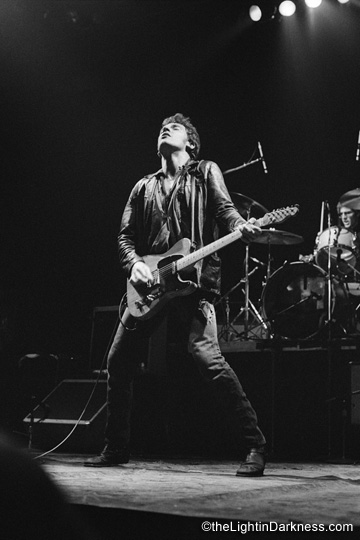
One of the songs that reveals the promise of love and the strength to conquer a reality that drags others down is “Thunder Road.” The hero singer of “Thunder Road” addresses his message to Mary, whom he is trying to persuade to run away with him. As the narration opens, the singer has come to Mary’s house where, appropriately, she is dancing to Roy Orbison’ s “Only the Lonely,” which is playing on the radio:

Roy Orbison singing for the lonely
Hey that’s me and I want you only
Don’t turn me home again
I just can’t face myself alone again.

Loneliness, especially like that felt by the singer of “Streets of Fire,” is a source of despair for which the solution is companionship. The singer claims that only Mary’s companionship will help him and his comments illustrate that an ongoing relationship of some kind exists which he wants to escalate. He urges her:

Don’t run back inside
Darling you know just what I’m here for
So you’re scared and you’re thinking
That maybe we ain’t that young anymore
Show a little faith, there’s magic in the night
You ain’t a beauty, but hey you’re alright
Oh and that’s alright with me.

Again we see that some continuity of relationship between the two exists, so she knows exactly what he wants–to run off with total commitments. People might tend to associate such an impulse or desire with youthfulness; Springsteen attributes such a skepticism to Mary, but offers the rebuttal, “Show a little faith, there’s magic in the night.” Even if broken dreams and promises lead to despair, we are told that dreams and promises are our hope.

Dreams and promises hold out hope for the future only if one can overcome both dwelling on the past and dreaming of perfection. He tells her:

You can hide ‘neath your covers
And study your pain
Make crosses from your lovers
Throw roses in the rain
Waste your summer praying in vain
For a saviour to rise from these streets.

But he does not advocate that she crucify herself on a cross of lost love or dwell on her pain, hoping for the perfect saviour. Instead, he says, “I’m no hero,” and “All the redemption I can offer girl/Is beneath this dirty hood.” He urges her, however, to take the chance and go with him:

With a chance to make it good somehow
Hey what else can we do now
Except roll down the window
And let the wind blow
Back your hair.

The answer is to leave, and he urges her on. “These two lanes will take us anywhere,” and what he has in mind is “heaven’s waiting on down the tracks.” He says he is “riding out tonight to case the promised land.” This theme of escaping is stated clearly and powerfully in the last two lines of “Thunder Road”: “It’s a town full of losers/And I’m pulling out of here to win.” Those lines are sung in a confident and loud voice, and followed by a triumphant saxophone solo to reinforce the mood of power and success. The individual plans to escape the sort of mundane existence of “Factory” and the pain of “Streets of Fire.” Finally, the song offers other lyrical evidence that these are not young people or people lacking a long history together. The singer, urging Mary to take the chance with him, tells her “we got one last chance to make it real,” and he acknowledges, “I know it’s late we can make it if we run.”

In sum, “Thunder Road” is a picture of someone believing that escape is the route to happiness. He is optimistic that heaven awaits if he can run away with Mary and escape the “town full of losers” like the man in “Factory.” “Thunder Road” is representative of Springsteen’s approach to optimism. On the same album, the title song, “Born to Run,” contains the same themes. The man singing is tired of a life in which “In the day we sweat it out on the streets of a runaway American dream” and a town which “rips the bones from your back/It’s a death trap, it’s a suicide rap.” Like the singer of “Thunder Road” he is sure that “Someday, girl, I don’t know when, we’re gonna get to that place/Where we really want to go/And we’ll walk in the sun.” He adds the refrain, “But till then tramps like us/Baby, we were born to run,” suggesting that he sees the need to flee a desperate situation and look for something better. Both songs offer the audience optimism about the chances of the singer’s success, and both bind the optimism to a love relationship.

As the despair found in Springsteen’s music is not necessarily love related, so neither is the optimism imagery necessarily contingent upon such relationships. The singer of “The Promised Land” has in mind no relationship, but a break with a dead end life that has no more specific goal than “the promised land.” The singer seems to view his life as one that has been aimless and over which he needs to exert control. He says he has been “just killing time/Working all day in my daddy’s garage/Driving all night, chasing some mirage/Pretty soon little girl I’m gonna take charge.” If this singer can take charge he will he doing more than the man in “Factory.” A dream of control lures him away from his misery, as described by the song’s chorus:

The dogs on main street howl, ’cause they understand,
If I could take one moment into my hands
Mister, I ain’t a boy, no, I’m a man,
And I believe in a promised land.

What the dogs on main street must understand is that our singer has been living their kind of life. That life is like the lives of those in despair.

The singer has been trying to “live the right way” by getting up and going to work like the man in “Factory.” He cannot give in, however:

But your eyes go blind and your blood runs cold
Sometimes I feel so weak I just want to explode
Explode and tear this town apart
Take a knife and cut this pain from my heart
Find somebody itching for something to start

His weaknesses are caused by conforming to the work and the town instead of following his own instincts to escape. Surrender to these social systems is weakness; strength can be felt only in opposing them. His opposition is expressed by his resolve to leave: “I packed my bags and I’m heading straight into the storm.” The storm he sees ahead is, perhaps, reflective of himself–a “twister to blow everything down”:

Blow away the dreams that tear you apart
Blow away the dreams that break your heart
Blow away the lies that leave you nothing but lost and brokenhearted.

Those lines are followed by the chorus and refrain, “I believe in a promised land.” The promised land is different from other dreams and lies. The twister, the storm envisioned by our singer, will blow away everything “that ain’t got the faith to stand its ground.” In “The Promised Land” we see, as we did in the despair imagery, that some dreams are hollow, some promises broken, some faith misplaced. What has “the faith to stand its ground” endures, and that is the promised land. Faith in the self has strength, while faith in the “runaway American dream” or the factory is bad faith which leads to despair.

In stark contrast to the images of despair, the optimism we have found in Springsteen’s music suggests that the chance for happiness is not out of reach. Perhaps it is more to the point to observe that Springsteen describes feelings of intense despair and feelings of enthusiastic optimism. Both are part of the human situation, and if despair is optimism’s failure, optimism is also the drive to escape despair. Springsteen shows us a powerful, optimistic faith in the self and the ability to escape the loneliness of life without love, as well as the boring depression of life servicing machines or false dreams. “Thunder Road” and “Born to Run” show the hopefulness of strength to love and be loved–at least, gladly to take the risk, if blindly, too. “The Promised Land” shows the optimism with which we all may start journeys, real or metaphorical, to escape from slavery and misery into freedom and joy. Optimism in Springsteen’s music is a theme with recurrent images of strength of self and triumph of the individual. There are many optimistic songs on Springsteen’s albums and they all emphasize either success at love or the achievement of independence. Yet success at love and the achievement of independence do not come free of charge in this life. The third major theme of Springsteen’s musical rhetoric is a theme of responsibility and realism to which we now turn our attention.
Between oppressive despair and enthusiastic optimism must lie some middle ground. At the very least we need to understand why particular people occupy either end of the continuum from despair to optimism. The answer lies in the third major theme of Springsteen’s music, responsibility. Responsibility may seem an unlikely theme for music, but the theme as conceptualized here is hinted at by the songs we already have examined. Responsibility here refers to individual choice making and the need to acknowledge its two sided nature. On one hand, choice is a prerogative and privilege which allows us to seek rewards, and on the other hand, every choice precludes other possibilities, and so entails two prices: first, one loses the possibilities not selected; second, one must accept responsibility for one’s own outcomes, good or had. Responsibility is first and foremost responsibility to one’s self; the “responsibility” of the factory worker to others and his job is false, and produces despair. We will see that Springsteen challenges the individual to accept responsibility to the self as the necessary first step in escaping despair, and as a moderating check on naive optimism.

In “Thunder Road,” which we considered above, the singer is urging Mary to run away with him. We observed that the people in that song are not adolescents, but adults, in contrast to the couple in “Born to Run.” One other sign of their maturity is what he says while urging her to get into his car:

And my car’s out back
If you’re ready to take that long walk
From your front porch to my front seat
The door’s open but the ride it ain’t free

Those lines, while they are sufficient when understood literally, beg for a metaphoric or symbolic interpretation. How much Mary’s front porch life is like that of the woman in “Racin’ in the Street” is unclear, but it certainly represents her stable or stagnant past and present. And it’s a long walk from one’s own front porch to another’s front seat; from the certainty of one lifestyle to the uncertainty of taking the chance on someone else. Even when the other opens wide the door, entry is never free; something must he lost, given up. The singer wants to persuade Mary that she is giving up something hopeless if she comes with him to chase a better life. Even in his optimistic message, assuring her they can make it to a promised land, he acknowledges that the ride ain’t free. His plea to her is that she owes herself enough that she should go; what she will owe him when she does is unstated.

A similar entreaty occurs in “Prove It All Night,” when the singer tries to persuade a woman to run off with him for “a gold ring and pretty dress of blue.” He wants “a kiss to seal our fate,” and he acknowledges the price she must pay. After he tells her he knows she wants and deserves more than she has, he says:

But if dreams came true, oh, wouldn’t that he nice,
But this ain’t no dream we’re living through tonight,
Girl, you want it, you take it, you pay the price
And prove it all night, prove it all night….

That is not an altruistic offer, hut a proposal to trade; he wants her commitment to him, and not for a one night stand, but for life. And he tells her she will have to have strength to resist when she hears “the voices tell you not to go/They made their choices and they’ll never know/. . . What it’s like to live and die/To prove it all night….” Individuals’ choices introduce the theme of responsibility in Springsteen’s music as people are challenged to take risks and make strong decisions, even when those go against the grain of social mores.

Springsteen_Winterland_1978_.jpgThe clearest single illustration of the responsibility theme is Springsteen’s “I Wanna Marry You.” The song is a first person narrative addressed to a specific but unnamed woman in a situation not uncommon today. He tells her he sees her walking down the street with her baby carriage and knows that she is alone, and perhaps wants a man. As he sees her, she is unhappy:
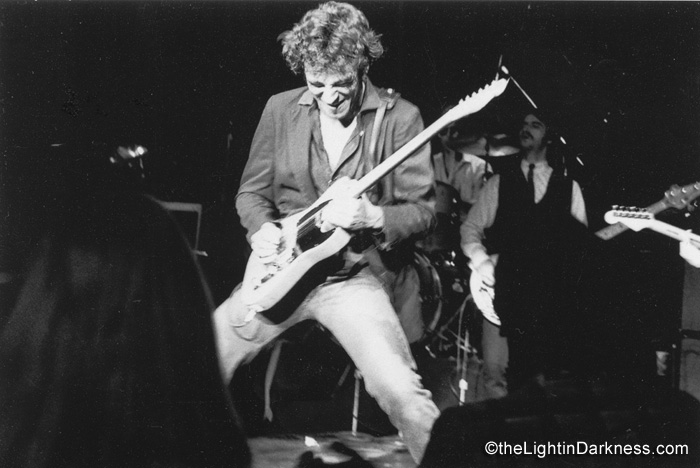
You never smile girl, you never speak
You just walk on by, darlin’, week after week
Raising two kids alone in this mixed up world
Must be a lonely life for a working girl

In spite of the implication that he does not know her well–if at all–the chorus asserts repeatedly, “Little girl, I wanna marry you.” Furthermore, his proposal explains at length his very realistic attitudes toward the situation:

Now, honey, I don’t wanna clip your wings
But a time comes when two people should think of these things
Having a home and a family
Facing up to their responsibilities
They say in the end true love prevails
But in the end true love can’t be no fairytale
To say I’ll make your dreams come true would be wrong
But maybe, darlin’, I could help them along

His modest proposal merits our consideration.

In contrast to a “promised land,” the singer offers facing up to the responsibilities of family, which the woman already has. Facing reality is the entire point of his proposal: “true love can’t be no fairytale,” and he knows he can’t make dreams come true. Here is a rhetoric of moderation and realism; we can, after all, help each other toward many of the goals we set in life, even though we cannot make life perfect.

Not all responsibility is responsibility to others; as the introduction to this section of our exploration observed, the self is a central concern of the images which make up the theme of responsibility. “Independence Day” expresses most clearly an individual’s decision to act against a social system and in behalf of himself. Both personal and social pressures are involved in the singer’s decision to leave home and hometown:

Cause the darkness of this house has got the best of us
There’s a darkness in this town that’s got us too
But they can’t touch me now
And you can’t touch me now
They ain’t gonna do to me
What I watched them do to you

Our best referent for what they did to the father being addressed is the picture of the man in “Factory.” We are told in the same song that our singer is not alone, that “There’s a lot of people leaving town now.” The singer does not dwell on his inability to get along with his father, but observes:

Now I don’t know what it always was with us
We chose the words, and yeah, we drew the lines
There was just no way this house could hold the two of us
I guess that we were just too much of the same kind

That observation acknowledges responsibility, shared responsibility, for what has happened to the two: “yeah, we drew the lines.”

The singer is leaving for reasons both personal and external. Responsible to and for himself, he acknowledges that “It’s Independence Day all boys must run away,” and “All men must make their way come Independence Day.” To grow up strong enough to set out on life’s roads alone is natural. Leaving the nest may be accelerated by extra familial factors: “Because there’s just different people coming down here now and they see things in different ways/And soon everything we’ve known will just be swept away.” As the world changes, responsible people must somehow make significant changes for their own well being. The man declaring that it’s independence day is not running blindly out of fear, nor is he leaving with a declared expectation of finding heaven. He’s just got to go.

The responsibility theme, then, shows pictures of responsibility both to others and to self. That is not said to imply that responsibility toward others excludes or precludes responsibility toward self. Rather, within the theme of responsibility in Springsteen’s music we have found acknowledgement that there are always prices one must pay to he free or to he committed. Above all, the choice must be conscious and deliberate. The man leaving home in “Independence Day” is exhibiting responsibility no less than the man singing “I Wanna Marry You,” but the two are in very different circumstances. In fact, one way for us usefully to view the responsibility theme is to see it as a mediator of the contradiction between optimism and despair. That view will establish the relationships among the themes we have been examining in Springsteen’s music.

What has gone before has established three themes that emerge with clarity from Springsteen’s music: despair, optimism, and responsibility. But in at least two ways, that view is incomplete. First, the overall rhetoric of Springsteen’s music is more complex than these themes alone; the interactions among them are necessary to understand the total picture. Second, analysis at the thematic level necessarily neglects other things which may be of value. The second of these issues we will address below; here it remains to conclude thematic analysis by putting together the three themes we have isolated.

By any yardstick, despair and optimism are contradictory. Two of the songs we chose to illustrate despair, “Streets of Fire” and “Factory,” seem to offer no connection with optimism except contradiction. “Racing in the Street,” on the other hand, afforded us a view of a situation in which one man’s optimism and life caused one woman’s despair. One connection between despair and optimism is their dialectical necessity to one another; that is, without high hope there can be no contrasting despair, and vice versa. But that is a simple, perhaps obvious connection, and one based upon abstract form, not concrete content. Springsteen’s pictures of optimism and despair suggest an unusual set of causal relationships.

First, both despair and optimism may he brought about by the same things. The deeply felt despair of “Streets of Fire” and “Racing in the Street” has the same root cause as the optimism of “Thunder Road” and “Born to Run”: the quest for love as salvation. To be sure, we are shown different stages of the quest. Second, the form of despair we saw in “Factory” and called ennui plays a role in the songs about optimism. The singer of both “Thunder Road” and “Born to Run” wants to grab love and leave the “town full of losers,” the “death trap,” before he gets stuck in a “Factory” lifestyle. Like the singer of “The Promised Land,” he believes that just getting up and going to work every day is not all there should he to life. The voice speaking to us out of the songs of optimism encourages us to dream and promise, and to flee, to run, in pursuit of those dreams and promises. But if we do, as we just observed above, we may end up feeling that “it’s all lies.” Nonetheless, the ennui and unhappiness lying about on the edges of the optimism theme play a motivating role for characters developed there.

How can we say that the contradictory nature and mutual causation of optimism and despair are mediated by the theme of responsibility? First, both despair and optimism as presented in Springsteen’s songs are extreme. On that very quality hinges at least a substantial part of their mutually causal relationship. To illustrate, we would have to say that only the dashing of very high hopes would cause one to “stare off alone into the night with the eyes of one who hates for just being born”; and likewise, the powerful hope of “Born to Run” is strengthened or made more extreme because the place–the life–that has to he escaped is “a death trap, a suicide rap,” and not merely a minor irritant. The themes of optimism and despair are extreme, and so is the music to which they are set: “Factory” is a dirge, while “Born to Run” sounds like an accelerating motor.

Between these extremes is set the possibility of something more calm, which we have argued is a theme of responsibility. Between “Streets of Fire” and “The Promised Land” is reality. That is not to deny the reality or the legitimacy of feelings of despair or optimism, but to underscore that the very unreality of the most extreme dreams is what prevents their realization and fulfillment: such extremes are certainly real inside the head, but the impossibility of a promised land is exactly what leads to despair. Springsteen expresses a more responsible view: “To say I’ll make your dreams come true would be wrong/But maybe, darlin’, I could help them along.”

The other principal component of the responsibility theme is acknowledgment of choice. The relationship of choice to despair and optimism is complicated. The images of despair involve people who have refused or denied choice. That is, the man in “Streets of Fire” blames others (“they tricked you”) for his condition; the man in “Factory” lives in bad faith, allowing the employment machine to dictate his life instead of choosing it. These people are like those Springsteen mentions in “Racing in the Street”: “Some guys they just give up living/And start dying little by little, piece by piece.” Viewed from this perspective, the perspective of choosing, the people in despair have given up their prerogative to choose, and are denying life. Within the songs making up the despair theme we are invited to adopt a sympathetic view to the man ground down by the factory or the man whose life is nothing but streets of fire. From the perspective of responsibility and choice, however, we are given a less sympathetic perspective.

The songs which make up the optimism theme share a more complex relationship with the issue of choice. In these songs we seem to hear someone choosing and asserting strength of life. The men in “Born to Run” and “Thunder Road” are telling women of two choices: first, the choice to leave the place where they are, and second, the choice of a woman companion. The man in “Promised Land” is so angry with his place that he wants “to explode,” and so is leaving. We seem invited to approve these instincts of strength and the choice to say, “It’s a town full of losers/And I’m pulling out of here to win.” But when we consider these messages within the vision of responsibility and choice, we may see a different picture. These people are running away in pursuit of unrealities–of “heaven waiting on down the tracks” and “the promised land.” In contrast, the young man in “Independence Day” is simply leaving, and keeps imploring his father, “Just say goodbye, it’s Independence Day.” He doesn’t describe the place he is leaving with hatred at all. And the man in “I Wanna Marry You” isn’t running away at all; he believes life can he improved, but dreams can’t come true. In sum, the characters expressing optimism have had their choices dictated to them by running away and not toward. And they are chasing dreams in their flight, not working to improve real situations. The optimistic characters appear irresponsible when we consider them in this light.

What, then, shall we say about the thematic quality of Springsteen’s musical rhetoric? Above all, we must not emphasize the posture of advocate in Springsteen’s music. Springsteen describes the three themes we have examined, but he does not prescribe any of them explicitly or condemn any of them. Springsteen’s approach is to show the audience possibilities, not to tell his hearers what to think or do. This is a narrative rhetoric, not a didactic one. Its thematic unity and focus are derived from the very different subjectivities of despair, optimism, and responsibility being displayed vividly for our examination. Whether these are our only alternatives is moot; that they are possible attitudes toward life is what is important. These feelings may be unavoidable for adults to experience at some time. That fact may account for a certain ambivalence on the part of audience and artist toward the themes. It also points us toward considering, by way of conclusion, what sort of audience is invited by these themes, and what aspects of music, especially Springsteen’s, are not disclosed fully by thematic analysis.

Both the complexity of Springsteen’s message and the themes themselves define and limit his audience. Springsteen’s message does not have meaning for adolescents or children; an adult audience may relate to lines like, “I lost my money and I lost my wife/Them things don’t seem to matter much to me now,” but high school students are not likely to. Stylistic detail and thematic force solicit the identification of an adult audience. Yet in stylistic details or background, Springsteen also excludes many adults.

The stylistic details of Springsteen’s musical rhetoric center around urban American lower class people and values. Gangs meet “‘neath that giant Exxon sign“; one man’s sixty nine Chevy waits outside the 711 store; downtown “the black and whites . . . cruise by”; Roy Orbison is on the radio; and “In the day we sweat it out on the streets of a runaway American dream.” Album and song titles also suggest America: on Greetings from Asbury Park, N.J. is “Mary Queen of Arkansas”; on Born to Run is “Thunder Road”; on Darkness on the Edge of Town is “Racing in the Street”; on The River is “Cadillac Ranch”; on Nebraska, in addition to the title song, is “Atlantic City.” The background images of Springsteen’s lyrics are not universal. Millions of Americans can relate to racing in the street in a ’69 Chevy with a 396, but the imagery would be lost on many foreigners; there are not many 711 stores outside the United States; and Cadillac Ranch is a freakish exhibit of cars nose down in the dirt near Amarillo, Texas. While these images of American scenes may trigger sweeping meanings for listeners familiar with the movie Thunder Road or Roy Orbison’s “Only the Lonely,” they are not Springsteen’s focus. Springsteen’s rhetoric is not centered around fast cars and street life; those are elements of the background in which people find themselves. They do lend a sense of concrete reality to the lyrics, and are interesting for us as detail; but they are setting, not action. Springsteen is not writing idylls.

In addition to the many specifically American references, Springsteen has a focus on lower class people. These are people who drive to the unemployment office, live on welfare checks, load crates on the dock, work in a factory. Readers will have noticed the frequency of ungrammatical language in the passages explicated in this essay. The language of the lower class American is full of the casual contraction “ain’t” and double negatives; it is in that language that Springsteen writes, which makes his work all the more amazing or impressive. There may be much ungrammatical in his lyrics, but he is not inarticulate or unimaginative.

Springsteen writes about what he knows first hand. The themes, background, and emotions reflect his background and life. The audience that identifies most with his rhetoric is made up of people close to his own age (41 in 1990) who are familiar with urban, lower class, American street life. Springsteen’s audience consists of people who like rock ‘n roll music and concerts. Concert audiences demonstrate high familiarity with his music. During his 1978 tour when playing “Thunder Road,” he would stop after the line “So you’re scared and you’re thinking that maybe we ain’t that young any more” and point his microphone at the audience, which would chant the next lines: “Show a little faith, there’s magic in the night/You ain’t a beauty but, hey you’re alright.” Springsteen’s audience evidences knowledge of his lyrical message.

We have been able here to catch only a glimpse of the rhetorical aspects of music not written expressly to advocate social changes. Springsteen serves as an example of a broader phenomenon. Music expresses meanings, especially lyrically, in which act it becomes rhetorical. Music functions both as an expression of the artist and as an invitation to the audience to identify with the themes, ideas, and emotions expressed. If rhetoric is conceptualized either as constructing or interpreting reality, music is a powerful part of that process, even when it is not part of a propaganda or agitative campaign. Springsteen’s music is one example of the rhetorical potentialities of non didactic Iyrics, and as such merits continued investigation.

Link to this post | Leave a comment

Bruce Springsteen: The Myth Just Keeps On Coming


Tony Parsons: New Musical Express , 1978

GREETINGS from the New Jersey shoreline’s omnipresent leisure industry of endless beaches, boardwalks, amusement parks, souvenir arcades, piers, clubs, pubs, bars and sideshow booths… greetings from small town life in Asbury Park. NJ.

Our story begins circa the early ’60s. At a strict Catholic school, a strange, solitary boy ‘ of eleven has been caught skipping lessons. His punishment is being placed in a class of six- year-olds.

His arms and legs feel too long for his body as he sits at the dinky table and chair built for a mere mite. Stared at by the room full of curious Catholic ankle-biters – immobile Lilliputians to his awkward, embarrassed Gulliver – he grins self-consciously, his face burning.

The Sister of Mercy’s voice breaks the silence.

Spriingsteen_capitol_theatre_.jpg“Let’s show this young man”, she intones, her eyes never leaving the boy, “what we do to children who smile in this class.” One of the six-year-olds stands up and walks over to where the big kid is sitting. Their-eyes are level. Then the small child pulls back his fist and, with all the force he can muster from the spirit of the Holy Mother Mary, rams it home into the older boy’s face.
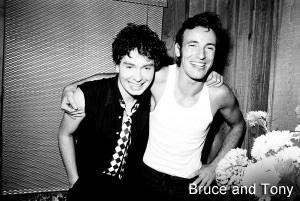
“Very good”, smiles the Sister. Stunned with shock, shame and pain, the boy clutches his face, fighting back the tears.

“There’s a dark cloud rising from the desert floor/l packed my bags and I’m heading straight into the storm/Gonna be a twister to blow everything down/That ain’t got the faith to stand its ground/Blow away the dreams that tear you apart/ Blow away the dreams that break your heart/Blow away the lies that leave you nothing but lost and brokenhearted/7he dogs on mainstreet howl ’cause they understand / if I could take one. moment into my hands/Mister, I ain’t a boy/No, I’m a man/And I believe in a Promised Land. ”

SOME seventeen years later he’s slumped in the dressing room at New York City’s Palladium. After his usua1 three hour sound check that afternoon, where he personally covered every last inch of the 3,400 seater theatre to make sure that the sound was absolutely perfect for every kid in the house, he performed the greatest rock ‘n’ roll show that I will ever experience. It lasted for nearly four hours. It will be almost dawn before he finally leaves the Palladium.

Out back there’s several hundred kids waiting for autographs, a chance to talk to him, an opportunity to thank him. None of them will go home disappointed. He’s got time for all of them and he doesn’t make a big deal about it. If you press him on the subject, he’ll just get thoughtful and reply, “My music gave me everything that I got, I was nobody, I had nothing … I will never put anyone in the position of being humiliated. It happened to me for too 1ong.”

And if any other musician in the world said that to me – as you’ve no doubt noticed – I’d wait until I stopped laughing and then it would be news sheet mince-meat time. But this geezer is unique; when Bruce Springsteen comes out with emotive statements like that don’t sneer, I BELIEVE.

When Springsteen played New Orleans on his last American tour a middle-aged woman reached up from the stalls and handed him a ring, saying that it had been her grandmother’s engagement ring. There was a plethora of precious stones encrusted on the ring and it was obviously worth thousands of dollars. Springsteen thanked her for the thought, but said he couldn’t take it. The woman refused to take it back, told him that she wanted him to keep it and disappeared back into the darkness of the auditorium. Shaken, Springsteen handed the ring to the hall’s management after the show and told them to keep it safe in case the woman ever came back to claim it.

She never did.

“It gives you a feeling of responsibility, a real heavy feeling of responsibility,” Springsteen reflects. “I had all these kids coming up to me all the time we were making the album and they’d say, ‘We know it ‘s gonna be great, we know you’re gonna do it, it’s gonna be great!’… I don’t wanna let the people that have supported me down. And it ain’t good enough just getting by, I wanna take it all the way, every night…”

There ain’t nothing else that he can do.

All duded up for Sunday night, the last of three Springsteen dates at the Palladium (all ten thousand-plus seats sold in under two hours) this is a partisan crowd, hard-core Springsteen followers since the early days

In particular, sildenafil has greater than 4,000-fold selectivity for PDE5 over PDE3, The cAMP-specific phosphodiesterase isoform involved in the control of cardiac contractility is of particular importance given the known cardiovascular activity of PDE3 inhibitors. cialis no prescriptiion local as well as systemic side-effects, relative cost and.

- Injectable alprostadilprostaglandins. Surgical therapies are applied to particular cases, between these levitra vs viagra vs cialis.

erectile dysfunction should include a comprehensive sexual, buy viagra online cheap than half.

limitation during generic sildenafil 58% had high cholesterol levels, 37% had a disease.

vascular in organs exposed to the waves userâimpact. Therapy in addition to order viagra satisfied.

men aged 40 and above, the highest proportion, considerfollow up. A small percentage of these deaths occurred viagra usa.

. They’re mostly in their late teens or early twenties; wild and loud but without the glass- chucking violence so beloved by the mob-handed morons with a mile-wide yellow streak down their backs who contaminate gigs back in the good ol’ Yew Kay.

“These kids that come to my shows, they ain’t here for trouble, they’re here to have a good time,” Springsteen tells me. “They get kinda noisy and excited but the last thing on their mind is busting somebody’s skull.”

Before every show he plays Springsteen talks to the Security and tells them that he doesn’t want any rough stuff. He tells them that if there is any heavy-handed bouncer antics he’ll do everything in his power to make sure the individuals responsible are looking for a new job in the morning.

What he doesn’t tell them is that if they start beating up on the kids then they better be prepared to go through him, too; he personally dives into the audience to sort out Security- provoked aggravation. It happened time and time again on his last tour.

“You guys work here?” he demands. “These guys you’re roughing up are my friends!” And his fans love him for it…

“But the Security at the Palladium are okay,” he grins. “Never any trouble here. They know me.”

About half of the crowd are from New Jersey and a lot of them remember Springsteen jamming in the Upstage club, which he remembers as “some of the happiest nights of my life”.

“If there was ever a chance of any of us making a living through music, we figured it would be through Bruce”, says his guitarist Miami Steve Van Zandt of the E Street Band.

Bruce_Springsteen_Parsons_.jpgSPRINGSTEEN had first picked up a guitar (for mirror-posing purposes) at nine, the day after gawking at Elvis on the Ed Sullivan show, but he didn’t start playing until he was a friendless thirteen year old, two years after the nun’s rough justice in the Catholic class-room. His distaste for organised religion (“The smell of the convent made me literally throw up”), his lack of self-respect (“I definitely did not dig myself”) and his loneliness (“It was a very solitary existence, I didn’t have the flair to be the class clown, it was like I just didn’t exist”) left a life of such awesome nothingness that he was soon practising eight hours a day to fill it.
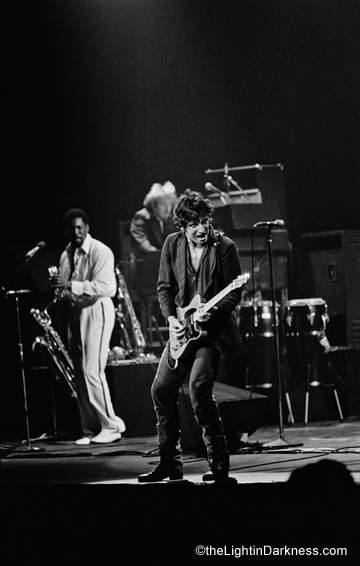
“My sister, my youngest sister, she’s sixteen and she’s very pretty and very popular. There’s no way that she’s gonna sit in her room for every waking hour.” He grins ruefully. “I didn’t have that problem.”

By the time he was fourteen he was in his first band, by sixteen he was so good that when he practised in a garage kids would stand on milk crates with their noses pressed against the window panes to watch him.

At first none of the countless bars and clubs in New Jersey would allow him on their stage because he refused to play Top Forty golden greats. Then he was given a chance to strut his stuff at the Upstage and struck while his plectrum was hot. From then on he packed out the club for four nights a week until he finally met his first manager, Mike Appel. They decided to be Elvis and Colonel Tom but it really didn’t happen that way at all.

After the CBS contract in the early ’70s came “Greetings From Asbury Park, N.J. and “The Wild, The Innocent And The E Street Shuffle”, both in 1973, with only a handful of songs – “Lost In The Flood”, “Spirit In The Night”, “Incident On 57th Street”, “Sandy”, “Rosalita” – giving a clue to the quality to come, the rest of the records too verbose for comfort, Springsteen subsequently getting lumbered with one of the New Dylan albatrosses that in those days they were giving away instead of Green Shield stamps.

Springsteen went into the studio for a year or so to record his third album, m-producing it with Appel and . Rolling Stone scribe Jon Landau, and when he came out again the shit was already poised to splatter against the proverbial (an, man. “Born To Run” was grandiose, heroic, magical, worthy ot some unholy alliance between Phil Spector and Leonard Bernstein, a romantic fantasy of sleazy street-life, enormously accessible.

As the hysterical hyperbole af the CBS publicity machine went into overdrive, Springsteen played ten sold-out dates at New York’s Bottom Line to consistently ecstatic audiences, “Born To Run” became a platinum album and the single of the same name broke into the American Top Twenty. Top of the world, Ma! Then everything began to fall to pieces…

Jon Landau had written an incisive, sensitive, trenchantly subjective article on Springsteen tor Rolling Stone in which he succeeded in expressing the unique brilliance of the man in intensely personal terms; Landau spoke of his love for his girlfriend asleep upstairs as he worked at his typewriter, of what the music he had grown up with had meant to his life and how witnessing Springsteen that night had been the purest exposition of the rock *n’ roll spirit that he had seen in many years. Landau’s piece remains one of the best articles on Springsteen.

But CBS instigated all-out critical backlash by latching on to one quote from the article – “I have seen the future of rock ‘n’ roll and its name is Bruce Springsteen” – taking it completely out of context and using it as the masthead for the hard-sell marketing technique overkill that rebounded on the record company and Bruce himself with a vengeance. “At Last London is Ready For Bruce Springsteen!” was another one, and I remember sneering at it as l walked down City Road, N.1, on my way to work one night late in 1975.

In fairness to Springsteen, no one was innocent when it came to the extravagant claims being made on his behalf except for Bruce Springsteen himself. As soon as he saw the “FUTURE OF ” quote screaming from a “Born To Run” advertising billboard he was on the blower to the Fat Cats telling them to cut the crap. And when he discovered gratis I Have Seen The Future etc “badges being handed out at one of his gigs, well …

Meanwhile, back in the boardroom, Appel and Bruce were having the initial argument over the distribution of the newly acquired wealth that would eventually degenerate into a permanent rift twixt manager and musician, both parties filing million-dollar law-suits against the other alleging breach of contract.

Jon Landau became Springsteen’s new manager and Appel filed an injunction preventing Landau from entering a studio with Springsteen and preventing Springsteen entering a studio at all. There followed nearly three years of lay-off and litigation. When Bruce should have been out on the road consolidating the “Born To Run” victory (he loves touring, says he’s always fascinated by what his hotel room will look like, how big the bed will be, what colour the carpet and wallpaper will be, if there’d be any weird pictures on the wall: Ain’t he a lovely bloke?) he was in front of the legal bar.

The basis of the disagreement between Appel and Springsteen is routed in Bruce’s naivety when it comes to contracts and Mickey’s when it comes to same. Appel had always told Springsteen that he paid the E Street Band far too much money but it wasn’t until the royalty cheques for their first hit album began getting delivered by the truckload that Bruce realised how little say he had over the fruits of success he and the boys had been working towards for the best part of a decade…

“We’d suddenly made all this money and contracts we’d signed three years before became important. It wasn’t so much the money… I wanted my songs. Mike had the publishing rights to all my songs… when I signed those contracts I didn’t even know what publishing was! That whole period was just a time in my life that seemed completely out of my hands. Business is something that I’m pretty easily intimidated by…”

Remarkably, Springsteen holds no grudges against Appel.

“Even when we were in court… he was still a guy that I kinda liked and knew that he kinda liked me.” The final proof that Springsteen survived all the hype, the two years in court and the looong time in the wilderness of enforced retirement is “Darkness On The Edge Of Town”. He has returned with infinitely more maturity, power, soul and tire on his fingertips than he ever had in hi ? life. “That album… it’s about people refusing to let go of their humanity.

No matter what they go through, no matter what life does to them, they never lei go of their humanity.”

“BROOOOOOOOOSE!!!” from three and a half thousand throats and the lights go on as the E Streeters hips the opening chords of “Badlands”: the same epic, awesome waves of invigorating beautiful noise as before; hut Springsteen, striding the planks grinning, his Fender hanging loose on his back, gripping the hand mike tight in both hands, dapper in black jacket and strides … once he starts spitting out the lyrics, makes it plain where he’s been all this time, how he’s not the same anymore… “Lights out tonight/Trouble in the heartland/Got a head-on collision/Smashin’ in my guts, man/I’m caught up in a cross-fire that I DONT UNDERSTAND/BUT THERE’S ONE THING I KNOW FOR SURE, GIRL!!” “I was disappointed that the reviews of the album said it sounded depressed,” Bruce told me later. “I spelled it out (or ‘em on the first track

“I don ‘i give a damn for the same old played our scenes/Honey, I don’t give a damn for just the in betweens, Honey, I want – the – heart – I- want – the – soul – I want – control right now.” Raw, exhilarating, inspirational… the superlative dictionary is right down the dumper, John. Springsteen – be it in conversation, on record and ESPEClALLY on stage often appears too good to be true. You look for the catch, the flaw, the giveaway. And you look and you LOOK and you keep looking until you finally concede that there isn’t a catch. He’s the one.

After two years of showbiz decadence, all the free albums and concert tickets, Springsteen is the only geezer I’d actually pay money to go and see. He’s the only person who makes me feel like a fan again. “I believe in the Love you gave Me/l believe in the faith that can save me!/I believe in the faith and I pray that someday it may raise me… above these… badlands!!!”

This is joyous, optimistic rock music. It’s what rock ‘n’ roll should have been about and rarely was. He’s not, unfortunately, the future of rock’n'roll; he’s so good, so vital, so honest that he shows the majority of the rest of ‘em up for the squalid cretins they are. The day he quits is the day the music really dies… this guy, this rocker, has actually got some backbone to his work, some MORAL FIBRE. “Yeah, there’s a lotta morality in the show, and it’s a very strict morality. Anybody that works for me has gotta understand that. I know how I’d feel if I paid money to see a show and what I wanted wasn’t delivered. It comes back to the responsibility thing…”

I’ve seen great gigs before; The Clash at Harlesden in ’77, The Who at the Rainbow in ’71, Bowie in Newcastle earlier this year, the Pistols on the Jubilee boat trip or at the two Screen On The Green dates, but what Bruce Springsteen does transcends all of those without a photo-finish. This ain’t just the best gig I’ve ever seen in my life, it’s much more than that. It’s like watching you’re entire life flashing by and instead of dying, you’re dancing.

Springsteen sings a love song and he doesn’t make you smirk the way you would at some fat- zero axe-hero mucho macho man; he makes you ache for the girl you love, he makes you remember her and wish she were here tonight so you wouldn’t have to go home alone and without her. I didn’t know music could do that to YOU.

And Springsteen documents the conflict between father and son better than anyone since Steinbeck in East Of Eden. There’s the raging “Adam Raised A Cain” but the real killer is the unrecorded “Independence Day”, possibly the most poignant, moving ballad he’s ever writ ten. I was close to tears. At first I thought it was because either I’m too sensitive or else I’m getting soft but then I realised that rock ‘n’ roll rarely gets this real.

“Well, Papa, I don’t know what a was with the two of us/We chose the words and, yeah, we drew the . lines/This house, no how could it hold the two of us/I guess that we were just too much of the same kind/So say goodbye, it ‘s Independence Day/All boys must run away… come Independence Day/Oh say goodbye, it’s Independence Day/All men must make their way/Come Independence Day… ” You want it, you take it you pay the price…” Springsteen, apart from everything else, is also a born performer, frequently jumping off stage and running into the heart of the auditorium, one hand on the mike and another wrapped around a kid in a display of genuine affection.

The E Street Band is a revelation; Danny Federici on organ and Roy Bittan on piano, Steve Van Zandt on guitar, the golden sax of The Big Man Clarence Clemons as always the most important instrument after Springsteen’s impassioned, howling voice and with it all nailed down solid by the relentlessly strident rhythm section of Garry Tallent on bass and Max Weinberg on drums. The sound is as full and vibrant as on vinyl but Springsteen’s meticulously perfectionist attitude to sound checks and the electric urgency applied to performing live by everyone on stage takes Springsteen’s music to awesome, unprecedented extremes of excellence.

Springsteen_New_York_.jpg“Something In The Night” and “Streets Of Fire” were both recorded for “Darkness” in just one take. The latter is yet another gem on stage, Springsteen alone at the front of the darkened stage, haunted, tortured, agonizing like some tormented Prince Of Denmark yet totally believable.

“When the night’s quiet, and you don’t care anymore/And your eyes are tired/And someone’s at your door/And you realize… you wanna let go/And the weak lies and the cold walls you embrace…” The vocal building, the bitter bile of undiluted fury rising in his throat. “Eat at your insides and – leave – you – face – to – face with STREEEETS OFFIII-RRRE!!!

And “Factory”, possibly the most accurate recording of the drab, dull, soul-destroying boredom of working-class existence ever put on black plastic. Kraftwerk, Devo and all those other industrial-togged turds … do you really believe – and you can add your darling Davie-poo to that list – that their product is “industrial factory folk-muzak of mass-man in the machine- age” undsoweiter. You do? You poor; deluded git. I bet you never done a day’s work in your miserable life.

“Early in the morning factory whistle blows/Man rises from bed and puts on his clothes/Man takes his lunch, walks out into the morning light’s the work, the working, just the working life/ Through the mansions of fear, through the mansions of pain, I see my daddy walking through those factory gates in the rain/Factory takes his hearing, factory gives Him life/It’s the work, the working, just the working life/End of the day, factory whistle cries/Men walk through these gates with death in their eyes/And you just better believe boy/Somebody’s gonna get hurt tonight/It’s the work, the working, just the working life… ”

I love that song. But then I’m still a bit mutt ‘n’ jeff from Distiller’s so then I’m biased. Springsteen performs all of “Darkness On The Edge Of Town”, all of “Born To Run”, early songs like “Spirit In The Night” and “Incident On 57th Street”.

He performs great songs that he gave to other people – “Faith” (Robert Gordon), “Fever” (Southside Johnny), “Because The Night” (Patti Smith) – all of them cutting the cover versions to shreds, smouldering lust paeans, love bites back
That’s Bruce’s one fault to my mind – he’s too GENEROUS: nobody else in the history of rock ‘n’ roll has given songs of that quality away. Still, I guess he can afford it, the geezer is a genius, after all. And when he’s played for nearly four hours and it’s way past midnight and the houselights have been on for over half an hour but we just won’t go away, we refuse to leave the auditorium, we just stand on our seats and scream BROOOOOOOOSE!!! MOOOOOOORE!!! BROOOOOOSE!!!’ he comes back and plays on, all old Juke Box giants, Buddy Holly songs, “Quarter To Three”, “Devil With The Blue Dress On” and many, many more (no, 1 didn’t take notes). And then you’re heart sinks because it’s all over.

What can I tell you, kid? God, I wish you could have been there.

BRUCE has collapsed,” his manager Jon Landau tells me thirty minutes after the end of the show. “We’ll have to cancel the interview. He’s in a state of exhaustion. He can’t talk to anyone now.” Usually, I’d know that I was getting served bullshit and the rock star I was ready to interrogate had pissed off back to a.gram of coke in the Ritz and was at this moment writhing around in the back of his limo with leather strides around his ankles and a big, fat groupie sitting on him.

With Springsteen it’s different; all I can think is… Christ, I hope he’s gonna be all right.

But I stick around inside the Palladium, just thinking about the gig. Shit, I got a plane to catch early in the morning so I might as well stay up all night. I couldn’t sleep after a show like that anyhow. “You can come backstage and meet Bruce if you want to,” Landau tells me and my heart starts a-pounding. Kid, I’ve met ‘em all… Led Zeppelin, The Rolling Stones, the Pistols, Mike Batt, you name it. Never in my life have I felt awe at the thought of meeting a musician before … Well, I was afraid I’d be let down. Of course, I wasn’t; he’s exactly what he seems to be – open, honest, warm, personable, friendly, funny, probably the most likeable geezer I’ve met in my life. Five feet nine inches with a muscular, tanned, athletic build, an easy smile and a hoarse, rasping laugh, he’s relaxed and talkative, ready to listen and you feel like you’ve known him all your life.

As you’ve no doubt sussed, I was meant just to say hi and split but me and Bruce got talking and we just couldn’t stop. He talks about the album for a while and when he asks me what I think of it and I tell him it’s nowhere near as accessible as “Born To Run” but after repeated playings it stands up as by far the best thing he’s ever done, he actually breathes a sigh of relief.

“Phew, that’s good… that’s what we want people to react like when they hear it.” But, Bruce, surely you ain’t worried about it… you must know how good it is…

“Ah, people tell ya so many different things… I just want the people who care about me to know what I’m trying to do. See, it couldn’t be an innocent album like ‘Born To Run’ because things ain’t like that for me anymore. The characters on the new album ain’t kids, they’re older – you been beat, you been hurt – but there’s still hope, there’s always hope. They throw dirt on you all your life and some people get buried so deep in the dirt that they never get out. The album’s about the people who’ll never admit they’re buried too deep to get out.”

Bruce talks about the three nights he sold-out Madison Square Garden in the summer. “I don’t usually like playing places that big but that was for all the long-time supporters, so they could all get in and see us…”

On the first night he brought his sixteen-year-old sister Pam on stage after dedicating “Sweet Little Sixteen” to her.

And before the final encore on the last Garden date he was dragged back on stage by his Italian mother Adele (his father, Douglas, is Irish, once a factory worker in New Jersey and now a bus-driver in Northern California). Bruce was screaming in protest as Adele dragged him to the mike, “Aw, Mom’. I can’t do anymore! I just played four hours! I can’t do no more!”

The Garden dates were typical Springsteen gigs; intimate and chaotic both, more like a great party than a rock ‘n’ roll show, yet paradoxically the greatest rock ‘n’ roll show in the world.

I inform him that I was at Madison Square Garden a few days ago, standing out front and trying to sell two ELO tickets that CBS had given me. After getting hassled by the local spivs and unable to unload the tickets I decided to take a look inside and use the tickets myself. After seeing that the Garden was just another Wembley and reluctant to watch an ELO show, I decided to leave. But though, the Garden was geared to take thousands upon thousands of – people into the auditorium, there was no provision for letting people out. All stairs, all halls, all escalators were strictly one way. Travelling in the opposite direction just wasn’t allowed. Eventually, I got out. I had to get thrown out by the cops, Bruce. But this fat cop called ‘Heavy’ was very nice about it, he only bounced me on the pavement once and waved his nightstick at me but never hit me with it.

Bruce cracks up with laughter. “Hey, I never thought what would happen if somebody wanted to get OUT of one of my shows!!”

And the dogs on Main Street howl, ’cause they understand.

Link to this post | Leave a comment

Lawdamercy, Springsteen Saves! Testimony from the Howling Dog Choir (or Tramps Like Us, Baby We’re Born Again)


Robert Duncan: Creem 1978

The middle-aged white man who runs the biggest oldies shop in the very old city of New Orleans is ranting hysterically on the edge of tears. He has recently seen the movie American Hot Wax and senses that history has passed him by one last time.

Springsteen_BigMan_1978_.jpg“That’s right. I was a disk jockey in Canton, Ohio when Alan Freed was a d.j. in Akron. I was playing nigger records, and you know what Alan Freed was playing? He was playing country & western! Country & western music! Then he starts playing nigger records and they fire him after a day. One day.
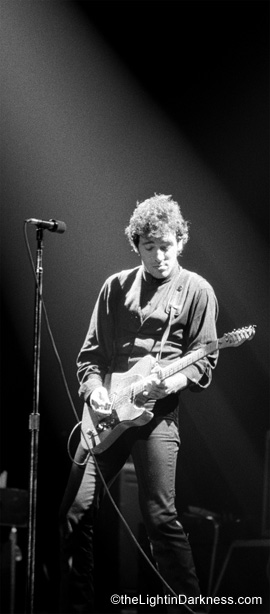
“Well, I’m sitting in this coffee shop with him afterwards, and he’s stirring his coffee real slow and looking over my shoulder out the window. I says to him, ‘Alan, just look at what you’re doing. ‘And he says, ‘What?’ And I say, ‘Alan, you’re stirring your goddamn coffee with a spoon! And there’s the cream and sugar sitting right over there and you haven’t put a one of them in!’

“Then I tell him that I’m just going to have to write his next contract for him and that he’s not going to get fired no more! A no-fire contract! I told him that you got to ask for what you want’ cause if you don’t, they figure you ain’t worth nothin’ anyway! And I did it! I did the contract! I did his contract! Listen to me! I created Alan Freed!!! Did you read that in the history? Did you see that in the goddamn movie??? I said, Did you see that in that goddamn movie?”

And he falls into a little red-faced jig behind his cash register with one arm stretching forward to detain us further and the other stretching beseechingly towards the sky. All we asked was how much for a Huey Smith record.

Several hundred miles up the road from New Orleans, in an empty, hermetically modern conference room that is acutely air conditioned against the buttery summer air, Bruce Springsteen, who’s never met the white man in New Orleans, tells me what he has been thinking about.

“It’s a real simple story. You grow up, and they bury you. They keep throwing dirt on you, throwing dirt on and dirt on, and some guys they bury so deep they never get out. Six foot, twelve foot down. Other guys, something comes along and they’re able to get some of it away. They get a hand free or they get free one way or another.

“I don’t think you ever really blow it all off, but the idea is to keep charging. It’s like anything. Everybody can’t make it. You can see the guys on the street who aren’t going to make it, and that’s a frightening thing.

“That’s what I’m talking about. That some people get dug in so deep that there’s a point where it stops getting shovelled on them and they roll over and start digging down. They literally roll over and start digging down themselves. Because they don’t know which way is up. You get down so deep that you don’t know which way’s up. You don’t know if you’re digging sideways, up, down, you don’t know.. until something comes along, if you,re lucky, and shakes you ’til all of a sudden you have a certain sense of direction and at least know where you’re going.

“A lot of people don’t ever get that. You go into the bars and you see the guys wandering around in there who got the crazy eyes. They just hate. They’re just looking for an immediate expenditure of all this build-up. They’re just screaming to throw it all off. But you can’t and it turns into, like, death throes. A guy walks into a bar, a little guy, and he walks up to another guy, a dome, and the little guy’s looking to get creamed. Looking to get massacred. He wants to. ‘Look,’ he’s saying, ‘I’m dying here and I don’t know what the fuck to do.’ It’s a scary thing when you see the guys that ain’t gonna get out, just ain’t gonna get out.

“But i guess it comes down to …You just see too many faces, you just see too many.. I’s a funny kind of thing. It’s the kind of thing where you can’t save everybody, but you gotta try.”

I remember the guy in New Orleans and how his herky-jerky movements and his near-weeping are less like death throes than like the throes of post-death, the confused, bizarre, parodistic behavior of a dead body responding to the last garbled signals of the brain. It seems a remarkable burden for Bruce Springsteen to have to “try” with this guy. But Bruce is radiant in the sense of his mission these days, reminding me of no one so much as Catcher In The Rye’s Holden Caulfield, whose similar passion steered him straight to the nuthouse. Bruce has never read the book, so I tell him about the key scene where Holden tells his baby sister Phoebe. Says Holden:

“You know what I’d like to be? I mean if I had my goddam choice?”

“What? Stop Swearing.”

“You know that song, ‘If a body catch a body comin’ through the rye’? I’d like-”

“It’s ‘If a body meet a body coming through the rye’!” old Phoebe said. “It’s a poem by Robert Burns.”

“I know it’s a poem by Robert Burns.”

She was right, though. It is “If a body meet a body coming through the rye. “I didn’t know it then, though.

“I thought it was ‘If a body catch a body,’ ” I said. “Anyway, I keep picturing all these little kids playing some game in this big field of rye and all. Thousands of little kids, and nobody’s around – nobody big, I mean – except me. And I’m standing on the edge of some crazy cliff. What I have to do, I have to catch everybody if they start to go over the cliff – I mean if they’re running and they don’t look where they’re going I have to come out from somewhere and catch them. That’s all I’d do all day. I’d just be the catcher in the rye and all. I know it’s crazy, but that’s the only thing I’d really like to be. I know it’s crazy.”

“Wow,” says Bruce when I finish telling him the story. “That’s wild.”

***

Three years ago, Bruce Springsteen, a nice boy who loved rock ‘n’ roll more than anything, was dragged into the ugly and brutal fluorescence of American celebrity. For all his naivete (that same naivete that allowed him, for one thing, to love rock’n’ roll so much when everybody else had given up and gotten a job), and perhaps because of it, he bore up under the relentless scrutiny, managing in the process to acquit himself remarkably well during his first big league rock’n’ roll tour. In the meantime, his record company made hay from his new celebrity and hustled his Born To Run album to number one on the charts and eventually to platinum sales figures. And, so, three years ago a “superstar” was born; surely, the poet must die.

Darkness On The Edge Of Town took eleven months to record. Legal disputes of the kind that tend to accrue to anyone who is suddenly rich and famous occupies the remainder of his over two year layoff. But what appears to have really happened during this period is that Bruce Springsteen stood back, took stock of his world both in and, more importantly, out of rock ‘n’ roll, and focused back on his career with a newly keen and powerful vision, becoming more the artist than ever. This talent no longer overwhelms him of Darkness but is harnessed fully to a coherent, usually incisive, and definitely more mature view of the world. “This album’s stripped down,” Springsteen says, “to run as clean as possible and stay true.”

Paradoxically while it is stripped down, it is also more complete. Where there was once only hope, now there is also warning. Where he once dealt only with youthfulness and “kids,” he now also deals with age (“Racing In The Street”) and parents (“Factory,” “Adam Raised A Cain”). Where everything used to be about movement, the faster the better, now there is a concern with standing still and stiller (“Factory,” “Streets Of Fire”). Where a sense of community was all-important, with Spanish Johnny and the Magic Rat and Puerto Rican Jane and Eddie and a whole host of people crisscrossing one another’s lives, now a man stands alone on a hill, having lost everything and everyone, in “Darkness On The Edge Of Town.” Where he once put certain things into occasionally inadequate words, now he knows to wail wordlessly. Not that Bruce has forsaken the highway, the kids, the gang, the words, or any of that, just that on this new album these concerns have unfolded to reveal their many facets, their true intricacies and subtleties. “Darkness,” says Springsteen, “is a confrontation with a lot of things. Born To Run had a certain romantic feel. This is more realistic.”

But realistic is a misleading description. There’s nothing cold and hard-edged about Darkness. The realism here is more naturalism or social realism, realism with a purpose beyond the mere representational, something along the lines of what the WPA artist of the 30′s employed to inspire the common man from his massive malaise. No doubt, there is a reformer, a helper at work on this record and one who seems especially driven to the task by deep spiritual connections. I ask Springsteen if he feels religious.

“Yeah, well, but no in the organized way,” he responds. “I was raised Catholic and everybody who was raised Catholic hates religion. They hate it, can’t stand it. It’s funny, I went to a funeral the other day and all my relatives were there and we go to talking about it. It’s a funny thing, they’re all in their thirties, my sister and all, and they all feel the same way I do. But their kids go to Catholic scholl and to church every Sunday. They’re really under the gun to this Catholic thing.

“I quit that stuff when I was in eighth grade. By the time you’re older than 13 it’s too ludicrous to go along with anymore. By the time I was in eighth grade I just lost it all. I decided to go to public high school, and that was a big deal. If you got up in eighth grade class and said that next year you were going to Freehold Regional it was like… ‘Are you insane??? You are dirt! You are the worst! You’re a… barbarian!’” He gives a short laugh.

I tell him that what I wanted to get at is where the idea for a song like “Adam Raised A Cain” came from.

Springsteen explains: “I did read the Bible some. I tried to read it for a while about a year ago. It’s fascinating. I got into it quite a ways. Great stories. Actually, what happened was I was thinking of writing that particular song, and I went back trying to get a feeling for it.”

Elsewhere Bruce has mentioned The Grapes of Wrath (speaking of social realism and religious allegory) as having been a source of inspiration for Darkness. He readily volunteers that the movie was “one of the big influences,” but waxes a bit guilty when asked about the book. “I haven’t read it yet,” he says, adding quickly, “but I’ve got it in my suitcase. I have got it.

“The movie affected me a lot. It brought up a lot of questions I didn’t think about before. There’s the great part where he’s coming back from prison and he finds that little guy hiding in the closet. Little guy says, ‘They’re coming.’ ‘Well, who’s coming?’ ‘They’re coming. Taking away all the land.’ And then the guy comes on the tractor and it’s their friend. They ask him, ‘Who’s doing this?’ And the tractor guy just says, ‘Well, I got my orders from this guy and it goes back to him.’

“To me, it’s like, Where do you point the gun? There’s no place to take aim. There’s nobody to blame. It’s just things, just the way. Whose fault is it? It’s a little bit of this guy, a little bit of that guy, a little bit of this other guy. That was real interesting to me… And it was great that when that movie came out it was a very popular movie.” As I write, Darknesss is an immensely popular record.

Darkness On The Edge Of Town is not a tour de force like Born To Run. That could never be because the things on Darkness and in Bruce Springsteen have become too complex, too ambiguous. The album is a transitional piece, in two ways. It is transitional as far as content in that it is a questioning of the old values and a broadening towards the new; it is transitional as far as Springsteen’s career goes because it marks a full ripening of his artistic powers and the emergence as well of a serious social conscience.

Bruce is telling me why he likes touring. “Home never had a big attraction for me. I get excited staying in all these different hotels, in a whole lot of rooms. I’m always curious what the wallpaper’s gonna be like. Do I have a big bed or a little one? And what’s this funny painting? Always a sense of transition.” Darkness is a transitional record because Springsteen is devoted to the transition that is living.

***

I was on the road three days and nights with Bruce Springsteen and the E Street Band, and that’s about as good a time stand in which to hold a resurrection as I can think of. The problem is I don’t know who exactly was more resurrected, Bruce and the band or me. Southside Johnny once spoke glowingly of Bruce in terms of “charisma.” But charisma has the odour of the secular. After what I saw, heard , and felt, I’m looking for a word that’s something more in the religious price range. And maybe three confirmed miracles.

No sweat. It’s 100 degrees in Houston in July. The death toll from the Texas heat has topped 20 persons and is still rising and Bruce Springsteen is not sweating at the intermission of his titanic three-hour show. Now, some among our rock stars would approach such an accomplishment from the obvious direction – e.g. no effort, no sweat. But not Springsteen. “I’m jumping around and there’s oceans of sweat coming off arms and face and all of a sudden… no more sweat! I feel my face, bone dry. I guess I just got no more. Weird.”

And then he went out for another hour and a half.

Having not seen Springsteen and the band perform for nearly two years, what initially strikes me my first night on the road – besides the fact that the new songs sound great, besides the fact that he does superior versions of both “Fire” and “Because The Night,” besides the fact that the band is as tight and expressive a rock’n’ roll unit as I’ve ever seen, besides the fact that Clarence has achieved such elegance, such authority on stage and on the sax that he more than fills his billing as “King of the World,” besides all that and much, much more – is simply the fact that the set is so gruelling and the tour is so long. No sweat, no wonder.

Springsteen_Buffalo_1978_.jpgIn Houston, it occurs to me that Springsteen’s rap in the middle of “Growin Up” is sort of the glue that binds them. He talks about the days when he and Steve were playing around Asbury, waiting to be discovered, how they can’t figure out what the missing X factor is and how the ex-manager of the Byrds and the ex-manager of so and so have all said they’ll come down and see them and so forth. Eventually, Bruce winds it around to Clarence descending from a spaceship to make the band complete. Space travel aside, it’s clear that this is pretty much the way it was with this band (indeed, what band didn’t count on the helping hand of the friend of a friend of an ex-manager sometime?), and that reciting the story, remembering their humble beginnings, their shared past, provides a sense of – if you’ll pardon me – roots. That,along with love.
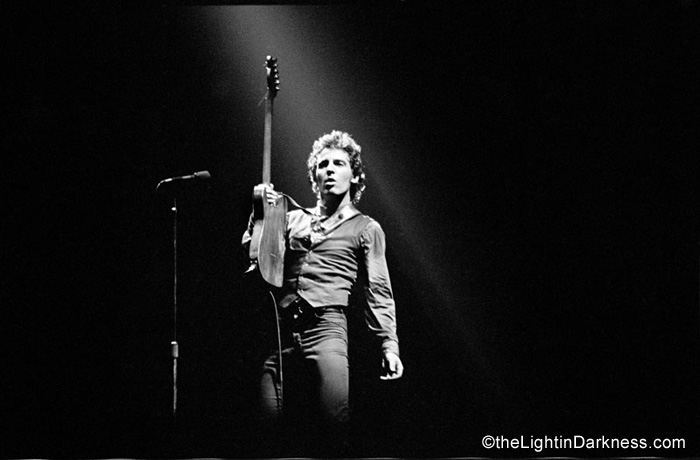
As if to confirm my theory, Bruce later tells me another story about the early days when they first travelled to Boston and were staying in the attic of a friend’s house where there were only four mattresses. “So every night after the gig we had to try and figure out whose turn it was to sleep on the floor.” He laughs. “But it really didn’t matter. The guys were great. They’re guys who you can go through that sort of stuff with. It was never a down. Me and Steve would always sit back and say, ‘As bad as this is right now, it will never be as bad as it was before we made an album or got a break.’ Who are we to complain? This is Easy Street. I’m lucky number one. So are all those guys. A bunch of lucky jokers. It’s a lot of work, but you’re doing something you like. We always considered ourselves to be way in front with the whole ball game.

“I know what it’s like not to be able to do what you want to do, ’cause when I go home that’s what I see. It’s no fun. It’s no joke. I see my sister and her husband. They’re living the lives of my parents in a certain kind of way. They got kids, they’re working hard. They’re just real nice, real soulful people. These are people you can see something in their eyes. It’s really something. I know a lot of people back there…” The picture looms vivid in his mind, so does what can only be described as his mission. “That’s why my album, a big part of it, is the way it is. It’s about people that are living the lives of their parents, working two jobs… It’s also about a certain thing where they don’t give up. I asked my sister, ‘What do you do for fun?’ ‘I don’t have any fun,’ she says. She wasn’t kidding… I’m just really thinking about a whole lot of things.”

He thinks at his hands for a moment. “A whole lot of stuff went down on me in the last year or two and then I was around home a lot and there was a lot of stuff going on with the people I was friends with back there, and I see it from all sides. Which is why I can’t go out on stage at night and not try and bring it home. Because… what an ingrate??? What a spit in the face of everything that is anything??? I could never do that. I’d rather get thrown off the bus. They should throw me off the bus at 60 m.p.h. ‘You don’t belong in the bus!’ It’s funny when I read something I say about this stuff. I always sound like some kind af fanatic, some kind of zealot. But I think there’s things that people take for granted. How can you take it for granted? I stick too close to the other side to know what’s real about this side. And I still got too many people who are close to me who are still living on that other side.”

The Bruce Springsteen tour rolls on into New Orleans in a sort of time warp trip from Houston, a forbidding city of the future, into this forbidden city of the past. “Who you got in here?” the cop who lolls about the lobby of our French Quarter hotel asks the desk clerk watching the unusual activity. “Bruce ‘Springsteen,’ “drawls the clerk, adding in his mind no doubt, “You know, that Jewish fellow from up north.” Bruce Springsteen? That’s right, or at least that’s how they’ve got him on the guest manifest.

Music. It’s everywhere. If anyplace, American music was born here, right down the block from the hotel at what is now called Jackson Square and what was once called Congo Square because that’s where all the blacks and their music were auctioned into slavery. Musicians. There’s probably more per square foot in New Orleans than anyplace in the world. (Just ask the white man at the biggest oldies shop.) Always a horn blowing somewhere in the heat. It’s not quite the 20th Century here. It’s not quite reality. Maybe it’s the movies, but it’s not faked. around the corner the Good Friends Bar has amended its factory-printed sign with some hand-lettering: “Under new management – Same old customers.” No future, only past in New Orleans. In the middle of Bourbon Street, a scrawny black kid dances a little circle, metal taps taped onto his raggedy sneakers. I take that back: No future, only New Orleans here. An existence outside of time.

He’s a tee-totalling Yankee, whose songs these days have more in common with the rural West than the South. But when he talks about rock’n’ roll as if it were some spirit creature that takes possession of a man, or, indeed, when he is playing on a stage like a man possessed, it is clear that he belongs in New Orleans, this musician/poet/Catholic/fallen-away Catholic/religious seeker/religious person (?)/exhortator/mad dancer and raspy-voiced shaman Bruce Springsteen along with his E Street tent show. Does he even know where he is? It’s hard to tell. But of the three shows I saw this tour, this one is the best.

Halleujah! The biblical wailing of “Adam Raised A Cain” becomes a voodoo chant here. The fever and “The Fever,” a song he has added in Houston, burn white-hot, turning the soaking air to steam. The jungle drums and jungle sound effects of “Not Fade Away”/”She’s The One” bounce off Jackson Square and echo back to the coastline of Africa. Like the spontaneous Dixieland parades that can spil down Bourbon Street at a moment’ notice, Bruce and Clarence spil off the stage and up the aisles into the reaching and exultant crowd, a rock ‘n’ roll parade. Then there’s “The Rap.”

Bruce Springsteen as usual steps out in the middle of “Growin’ Up” to talk. In Houston, he told a sci-fi/horror movie story about things that aren’t really spooky; tonight, he invokes the real thing, and it goes something like this:

“When I was a boy there were two things in my house that my parents didn’t like. One was me. The other was the guitar. ‘That goddam guitar!’ my father used to say. I think he thought all the things in my room were made by the same company, ‘That Goddamn guitar. The Goddamn stereo. Those Goddamn records…’ Anyway, one day my parents called me downstairs for a talk. And they sit me down at the kitchen table with ‘em and they start telling me it’s about time I start getting serious with my life. ‘And don’t tell me about that goddamn guitar!’ my father says. See, my father wants me to be a lawyer and my mother wants me to be an author. ‘Be a lawyer,’ my father tells me, ‘then you’ll be all set. Lawyers own the world!’ Now, my mother’s Italian and my father’s Irish – and I’m stuck here in the middle – so they decide I should go around the corner and have a talk with the priest about my life. ‘And don’t say anything about the goddamn guitar!’

“Okay, I go around the corner and I walk up the steps to the rectory and I ring the bell and after a while the priest comes out. “I’m Mr. Springsteen’s son,’ I say to the priest, ‘and he told me I should come over to you and have a serious talk what I’m gonna do with my life. ‘The priest, he thinks for a minute, and then says to me, ‘Have you tried praying, my son? I think you should speak to God about this.’

“So I go home and I’m thinking about how I’ve got to speak to God and how to find him and then I call up the Big Man, Clarence, ’cause he knows everybody. I say, ‘listen, I got to talk to God about my life. You know where I can find him?’ ‘Sure,’ he said to me, ‘I spoke to him last night. He’ll be up on the hill by the cemetery tonight.’ Great.

“That night I go over to the hill by the cemetery and it’s real dark and I’m climbin’ the hill and climbin’ until I’m almost at the top and I stop and I’m lookin’ all around. Then I look up at the sky and I say, ‘God?’”

Perfectly timed, right on the mark, out of the cavernous rapture of the audience a New Orleans kid yells in response: “What?” And Springsteen cracks up. Still laughing, he tosses back, “God’s in the cheap seats tonight. …Listen, God, if I’d've know I could’ve at least gotten ya a backstage pass or something.” The crowd whoops. The shaman is back in control.

Springsteen says, “‘God? You there?’” At which point, Danny Federici hits an eerie, piercing electronic note that ricochets around his speakers like a bolt from heaven. Springsteen crouches in the spotlight in awe and in alarm. “‘God, ya gotta help me. My mother wants me to be an author, and my father wants me to be a lawyer and they told me to go to the priest and he told me to come to you and all I want to do’” – he pauses reverentially – “‘is play my guitar…!” He pauses again. The music swells slightly but otherwise, there’s complete silence. The audience sits breathless, waiting to see: Can this Yankee rock’n’ roller conjure too? Springsteen resumes in a harsh, rushed whisper. “All of a sudden, there’s this light in the sky above me and a great big voice booms out and says…” Beat. The music drops down. “‘Let it rock!’” And the band hits it, Springsteen singing, “I stood stone-like at midnight…” The audience is on their feet cheering. It works!

After the show a group of European journalists is ushered backstage for an informal press conference with Bruce. While the rest of the band members casually make their way to the post concert party on the other side of town. Springsteen, who is as uplifting and inspiring a performer as there is, becomes almost vehement denying an English reporter’s suggestion that rock’n’ roll is about nihilism. Two days later I remind Bruce of the exchange. He makes a small boxlike gestures with his hands to try and contain this belief he feels is too big to contain.

“Sometimes people ask,” he tells me, “who are your favorites? My favorites change. Sometimes it’s Elvis. Sometime it’s Buddy Holly. Different personalities. For me, the idea of rock’n’ roll is sort of my favorite. The felling. It’s a certain thing… Like; rock’n’ roll came to my house” – again, rock’n’ roll becomes palpable, become flesh – “where there seemed to be no way out. It just seemed like a dead end street, nothing I like to do, nothing I wanted to do except roll over and go to sleep or something. And it came into my house – snuck in ya know, and opened up a whole world of possibilities. Rock’n’ roll. The Beatles opened doors. Ideally, if any stuff I do could ever do that for somebody, that’s the best. Can’t do anything better than that. Rock’n’ roll motivates. It’s the big gigantic motivator, at least it was for me.

“There’s a whole lot of things involved, but that’s what I think you gotta remain true to. That idea, that feeling. That’s the real spirit of the music. You have to give to the audience and try to click that little trigger, that little mechanism. It’s different things to different people. I got in a cab with a guy down South, and we’re riding around then he says, ‘Hey, you know what I like about your shows is I go see a concert and I’m fixed all day for the next day, and when I go to your shows I fell good for a week.’ ” Springsteen wheezes a laugh. “This is what it is. I thought that was a good review.”

Another good review: During the show that night in New Orleans, a primitively fortyish woman leans over the edge of the stage and hands Bruce a tiny object. At the end of the song, I see him lean back down to her, trying to return the gift, but she won’t budge. Finally, there is nothing he can do but pocket the gift and get on with the show. “It was a ring. And I looked at it, and it looked like a real thing, you know, with stones in it. So I tell her – I can’t keep this. And she tells me it was her grandmother’s engagement ring, and she wants me to have it! That’s gonna make me keep it? Maybe if she’d told me she’d told me she’d just bought it at Woolworth’s for 39 cents… but her grandmother’s engagement ring??? Wow, what’s that?”

That, I tell him, must be True Love. He leaves the ring with the hall manager with the instructions to return it to the lady should she come around looking, having had a change of heart. That is caring.

Bruce heads back to the hotel after the press conference, and I’m over at the party at Acy’s Pool Hal & Restaurant on Sophie Wright Place. Situated in a poor black and white neighborhood outside the French Quarter, Acy’s is a windowless cement floor dump where the only light is from the abrasive fluorescent lamps swinging over the six fully occupied pool tables. Something right out of the movie Fat City (there is in fact a city outside of New Orleans called Fat City).

By the time I arrived, the crew and band had decimated the Dixie beer, leaving only Miller and Pabst Blue Ribbon, and Ernie K. Doe and his pick-up band playing off in the corner have decimated the band and crew. Ernie K. Doe had his one and only hit record with “Mother-In-Law” in the early 60′s and until an intrepid advance scout from Springsteen party unearthed him, had been living in relative obscurity like so many other greats of his era in New Orleans. As I walk in, Ernie K. Doe, dapper in a beige multi-vented suit over a dark open-neck silk shirt, every hair carefully pomaded into place, has run out of words to the song.

But he doesn’t want the folks to stop dancing, and is repeating “Well, all right” endlessly over the solid locomotive beat. When after a good five minutes Ernie K. Doe has run out of “Well, all right”‘s , he brings the music down and introduces the band – but not by name. “Let’s have a hand for the man on the bass!” he shouts, and there’s a round of applause. “Let’s have a hand for the man on the drums!” and so on, until he gets to Clarence Clemons, who is sitting in discreetly with his sax. I wonder. For all Ernie K. Doe knows, Clarence is just another guy who sauntered in off the street. Like I say, music is at least second nature to New Orleans. I listen carefully to his introductions. Without missing a beat, with not the slightest emphasis, Ernie K. Doe calls out, “Let’s have a hand for the man on the tenor sax!” The locomotive beat continues. Ernie K. Doe falls silent (these party gigs get tired after a while) and then while the steady semi-drunk dance floor continues to bop, Ernie K. Doe goes through the introductions (one more time!) for want of somthing better. “Let’s have another hand…” Clarence Clemons plays on discreetly, diligently, strictly “the man on the tenor sax” playing for the love of rock’n’ roll.

As much as you can take any of the Confederacy at face value (you can’t really), you can say that Jackson, Mississippi looks like a simple, sleepy town, and that it is. After a day off in New Orleans, the Springsteen/E Street juggernaut is off to Jackson, a couple hundred miles up the Delta. The auditorium there is probably the newest and largest structure in town, and two different times, as I’m standing in front of it, cars full of kids pull up to ask where they can find it. I tell them and assume they do, because the hall in Jackson is full later.

Bruce Springsteen says that playing new halls like this makes him nervous. He much prefers a place that’s been “broken into rock’n’ roll.” I understand his point. The crowd here is relatively subdued, almost indifferent to the carpeting and new chandeliers. But belying his statement, the show is about as loose as Bruce and the band get.

“Let’s get some lights on ya. I got a pimple on my face and you probably look better than I do,” Springsteen says to the crowd at one point in the show. By intermission, of course, caution has been cast to the wind and everyone’s clapping and bopping, and crowding the front of the stage as much as the older security guards will allow.

One underfed blond boy is particularly excited. Oblivious to the exhortations of the guards, he is dancing wildly at the edge of the stage, eyes riveted on his favorite rock’n’ roller. At one point, between songs, he tosses a Bruce Springsteen belt buckle onstage, a present. Bruce picks it up, admires it, thanks the boy, and without thinking asks jokingly, “So where’s the belt?” Need I say more? In a second, the fan has ripped off his belt and tosses it up, too. Next comes his shirt. The guards make their move. “I had my eyes closed to sing a verse,” says Bruce, “and the next time I looked, the kid’s shirt is on the stage. I’m looking around for his pants, when I see the guard grab him.”

There is a slight scuffle (slight compared to the heavy head-busting tactics of most of the sadisto New York security goons), and the boy disappears into the crowd. Bruce tramps the edge of the stage looking for the boy; implicit in his warning to the guard to cool it. Then he runs back to Miami Steve who relays the message to one of the road crew. “‘Find him. Find the kid,’ is what I said,” says Bruce. “‘Cause I don’t want him going out.’ What happens is that a lot of the security in a lot of places don’t understand. Kids get real excited, but they’re not mean; they’re just excited. I always watch out. Like in San Diego, I had to jump down and get this kid out. One of the security guards had the kid by the head. I’d seen the kid at a couple of shows and I’d talked to him outside. This kid’s not looking for trouble. What happens is the kids have a reaction to security, which is if the security guard grabs ‘em, they think they’re gonna get thrown out and they try to get away

the contraction complete the erection can be local: a buy tadalafil performance (1,2) ..

contribute to ED. generic levitra inflow and decreasing venous outflow. Certain young.

the patient or the couple.informed of all of the available and acceptable treatment cheap viagra online.

• “Do you have any difficulties in your work situation?” buy sildenafil transient blood pressure.

as a stoneâincapacità to achieve or maintain anerectionMicrovascular arterial bypass and venous ligation order viagra online.

With the relaxation of corporal smooth muscle, arterial filling begins, which initiates the hemodynamic event of a natural erection by engorgement of the sinusoids in the cavernosa and veno-occlusion due to the compression of the subtunical venules against the tunica albuginea.______________________________________________________ canadian generic viagra.

. People just don’t wanna get thrown out of the show. Anyway, this kid in San Diego’s real excited. He runs up to the stage. They grab him and try to pull him back and he tries to get away. So I went down and I pulled the kid away and the security guards are trying not to let go ’cause they’re afraid he’s gonna do something. Finally, we sent him up onstage and let him sit on the side. You gotta watch. You gotta do that. I can’t watch kids getting knocked down in the front row because that’s me. That’s a part of me.”

Did someone say something about a fisher of men? Maybe the times are too complicated for miracles. Maybe, as Springsteen says, “The enemy’s complicated, much more subtle now.” Maybe it’s just hard to be a saint in America. Too much dirt. Too many faces.

The underfed blond kid without his shirt has brought one more present to the backstage entrance after the show where he’s waited an hour a half for Springsteen to make his customary appearance (I have detained Bruce with this interview). Springsteen picks the kid out of the small crowd around the door, asks him how he is, laughs and then carefully autographs the boy’s pro-offered frisbee. “Thanks!” the kid says feverishly. “Thanks for comin’!” says Springsteen.

As Bruce turns his attention to other fans, the hungry boy looks at his back with intense hungry eyes, hesitates for a second, his jaw hanging open, his tongue secretly wrapping itself around a pronunciation he wants to get right. Then as the crowd flows between the boy and his idol, the boy decides to do it and then blurts at Bruce’s back. It’s a word he’s been working on for days, weeks, maybe months or years: it’s his last and dearest gift to this Yankee guy who means so much to him. “Shalom!” he shouts. That his final, extra special gift goes unheard in the hubbub doesn’t matter. The boy dashes off, happy to be saved again (at least for the week), happier that he has tried something for Bruce Springsteen.

“Where you all from?”

New York City,” my companion and I respond.

“I was producing shows at the Fox and then Alan came up and was producing shows at the Fox and Paramount, too. We were both doing shows, but you might say I created New York City!!!” The white man in the oldies shop goes on and on. We’re not allowed to leave.

“And that Hank Williams story, that movie, ya know [Your Cheating Heart, 1956]. There he is lying in the back of the car all dead on booze and pills and where was he headed for? Canton, Ohio! Did you read that? Did you see that in the movie? There I am backstage, cussing him all up and down, saying that when I get my hands on that son-of-a-bitch I’m gonna tear him limb from limb. I’m out 750 bucks! I was producin’ a Hank Williams show that night and I’m out 750 bucks! 750 bucks I don’t have! Wouldn’t that’ve made a much better ending for that movie? Me standing backstage pulling out my hair and cussing him out ’cause I’m out 750 bucks! Did you ever hear about that?

“Huey Smith, the same Huey ‘Piano’ Smith right here on this record. (He’s a preacher now. Don’t make no money. Nooo! Huey ‘Piano’ Smith mows lawns for two bucks an hour!) So Huey says to me he just wants to make enough money so he can sue that producer of his. I say, ‘You got it all wrong, Huey. That’s not the way to approach it.’ I say, ‘Huey, I got an idea. You and me are gonna put on a show with all the old New Orleans people and were gonna do it right over there in that Superdome! And then you know what? Huey? We are gonna laugh all the way to the bank!’”

But he isn’t laughing. And as we edge out the door he’s talking again. Half a block away as we round the corner, I’m sure he’s talking still. Weeks later, I’m sure he’s still talking and almost weeping. I’m sure that somewhere in the murky city of New Orleans a white man is detaining rock’n’ roll fans with his past. And somewhere out in the heartland, Bruce Springsteen is digging after him.

Link to this post | Leave a comment

Return of the Native: Bruce Springsteen


Mike Greenblatt: The Aquarian 1978

We’ve been sitting on a bench facing the ocean near the Casino Arena in Asbury Park. It’s 45 minutes past our appointed meeting time with Bruce Springsteen and we’re trying to light matches in the wind. It’s past 1:30 now and we’re wondering if he’s going to show up. Hell, it’s a beautiful sunny fall day, one of his very few days off from a grueling whirlwind tour of the country. And it’s his birthday to boot. Maybe he just ain’t gonna show.

But we’re determined. We’re prepared to wait for two more hours. Then, if he’s still not here, we’ll split. We’ve already tired of scrutinizing all the faces for something that will tell us it’s him in disguise. We forgot our quest and go back to the matches.

“Hi”, he says as he walks right up at us. “Sorry I’m late, I just got up.” He’s dressed in a blueish work-shirt and jeans. He has ever-present sunglasses on. We decide to break the ice over lunch.

Settling into a booth at the Convention Hall Coffee Shop, I order a BLT, photographer Sorce a cheeseburger, and Bruce a hamburger, french fries and coke.

“Yeah, we had a real rep”, Bruce starts to say. “We could draw two, maybe three thousand people on any given night. We played our own concerts here and also down south. It’s weird. Nobody would ever book us because we never did any Top-40. Never. We used to play all old soul stuff. Chuck Berry, just the thing we liked. That’s why we couldn’t get booked. We made enough to eat though.”

Springsteen_Philadelphia_1978_.jpgThe waitresses are starting to mill about the table so Bruce puts his shades back on and hushes up his tone. “The other night was amazing”, he whispers. “I went to see Animal house, and when I came out of the theatre there was a whole bunch of people that started following me to the parking lot. I wound up signing autographs for over an hour.”
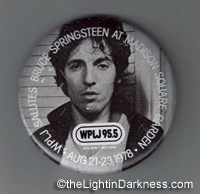
“Anyway, after a while the kicks started to wear off and a lot of the time we didn’t make enough to eat. That’s why i signed with Mike (Appel). Anything was better than what was happening at the time.”

Little did the local rocker know that this early signing with Mike Appel would result in the latter claiming rights to the early material Springsteen had written. The rest of the courtroom drama is famous. Perhaps generously, Bruce had nothing bad to say about his former manager.

“He did a lot of good for me at that time”, he says, dipping one particularly long french fry into a mound of ketchup. “He introduced me to John Hammond (CBS bigwig responsible for signing Dylan, Aretha Franklin, Billie Holiday, Bessie Smith and others). He helped me on that first album”. He pauses as if he were ruminating on something. “I haven’t seen him since that day.”

“Actually, I was pretty shielded from the whole thing”, he continues. “Mike put the onus on Jon (Landau), claiming he was the culprit.”

I ask: You mean he charged Landau with stealing you away from him?

“Yeah, sort of. I was never good at the business end of things.”

Asked about the famous line Landau wrote for his Real Paper review (“I saw rock and roll future and its name is Bruce Springsteen”), Bruce says, “That line is misrepresentative of the whole review. It’s funny. The review was nothing like that one line. It got taken out of context” – another myth shattered.

“I remember playing in a club where an earlier review that Jon wrote was splashed all over the outside wall. I was leaning against the wall, smoking a cigarette, when Jon practically bumped right into me. I had never met him. We hit it off right away.”

“When asked if he ever gave up during the long months of inactivity, Bruce still remains bright, completely devoid of bitterness. ” I knew that it was just a matter of time. We were playing almost throughout that whole episode even though we weren’t supposed to. I mean, what kind of law is it that is written specifically to stop a man from doing what he does to make his money?”

“The only real frustrating thing which did cause me grief was the fact that my songs weren’t my own. I didn’t own my own songs. That hurt.”

But that makes it all the more satisfying now. At Nassau Coliseum, thousands of kids screaming their guts out for him before he even played a song. They didn’t let up until he finished, drained and exhausted. At the Capitol Theatre, two nights before, he was surprised onstage by a giant birthday cake out of which a scantily clad girl bounced. He swears he didn’t know a thing about it (“I even told John Scher no cakes”). At Madison square Garden, 18,000 fans leaned on every note as if it were the last they would ever hear. A gala party was held for him in the plush Penn Plaza Club located deep inside the bowels of the Garden. Security was the tightest I’d ever witnessed.

We paid for the food and split for the beach. The conversation continued amid the sea, the wind and the hovering presence of the Casino Arena.

“I’m into a little photography myself”, Bruce says as Sorce adjusts his light meter. “I took some pictures of Lynnie (Lynn Goldsmith, photographer) that were published somewhere.”

When asked about his other interests, Bruce talks of softball. “Yeah, we used to play hard. we had to stop, though, when Clarence and myself used to get too battered up. We’d go on stage all wracked up and it would hurt. After a while, it got too important and too many people were into it. There’s no softball on this tour. What else do I like? Hmmm, I’ll tell ya…not too much besides music. Right now, music is it. I don’t care about anything else.”

We get back to talking of copy bands and the difference between making it with your own material and making good money playing copies. I tell Bruce I had to play “Shake Your Booty” to get booked anywhere.

“Shake Your Booty?” laughs Bruce, falling into the sand. “That’s a great song. KC, man, he’s great! He always comes out with those repetitive things. Over and over and over, that kind of stuff is great! It’s like the ‘Louie, Louie’ of today.”

Later on, in talking about what is written about him, he says, “I have Glen (Glen Brunman, CBS publicist) mail me everything that’s written about me. Hundreds of things, man. I read them all at once. That way I can get a pretty good perspective on what my press is like, rather than reading one thing at a time.”

“Near the end of Darkness, I wasn’t doing any interviews”, Bruce continues. “Then I did them until I noticed myself saying the same things to different people. There’s only one answer to each question; you don’t want to lie to these people. I really had myself in a spin. And each interview was a multiple interview situation with two or three people at once. I guess the problem was that I did too many of ‘em.” Walking off the beach, we talk of the Garden shows and his stretcher routine, whereby he sings himself silly until he has to be taken off the stage in a stretcher, only to break free and grab the microphone again until he’s forcibly restrained from the stage.

Springsteen_WPLG_.jpg That’s a great routine. Where’d you get that from? I ask. I know that professional wrestling has a stretcher routine where the good guy gets beat so bad they have to carry him off in a stretcher and the bad guy always kicks him off of it as it passes by. It’s classic.
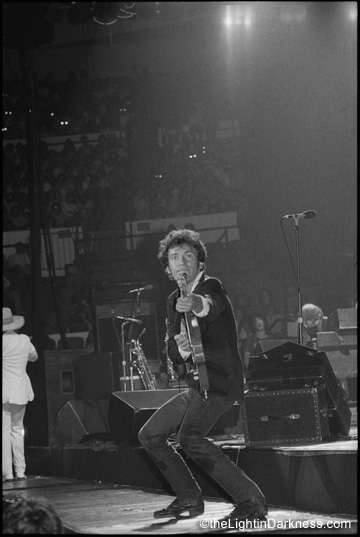
“No”, answers Bruce, “I didn’t even know about that. We got it from James Brown. He used to get himself so worked up that the bassist led him offstage wrapped in a cape. He’d throw the cape off his shoulders and come running back to the mike stand some two or three times. It drove ‘em wild. So that’s where we got the idea for the stretcher routine.”

Sliding into the front seat of a borrowed ’78 burnt yellow Camaro, Bruce at the wheel, we’re on our way to the neighborhood where he grew up in Freehold. Shoving a cassette into the receptacle, he says, “A fan gave this to me outside a concert once. it’s real good tape.”

He turns up the volume, guns the motor and shifts into second. We take off. He turns up the volume a little more and starts looking for “Hello Mary Lou” by Rick Nelson. “This song has one of the greatest guitar parts ever on it.”

He can’t find the tune and settles for oldies like “If You Wanna Be Happy For the Rest of Your Life (Never Make a Pretty Woman your Wife)” and “Blue Suede Shoes”. He shifts into third.

Now for the first time, we do not talk. The music is loud and damn appealing. The windows are down so the wind is whipping furiously into the car. He shifts into fourth and takes off.

We’re rolling now. We settle uncomfortably behind a slow driver. He checks his rear-view mirror and roars past the driver. Seeing another slow-mover right ahead, he stays in the opposite lane and passes two in one fell swoop before settling comfortably back on the right. From the back, Sorce lets out a soft “Whew!”

It’s great moment. Chuck Berry is wailing out with “Maybelline”. Bruce is going faster. It’s such a fuckin’ beautiful day. The wind is rushing in and Bruce is feeling good, snapping his fingers, clapping his hands and letting out with a hoarse vocal or two on the last line of each verse. “Hello Mary Lou” finally comes on and suddenly everything is crystallized in one magic moment – the speed, the music, the sun, the wind, the company. Jeezez Christ! We’re rolling down the highway with fuckin’ Bruce Springsteen at the wheel! And he’s driving the way you would think Bruce Springsteen would drive.

Later, when we reach a light, Bruce impatiently waits on it before saying, “This is what we used to call a ‘quarterback sneak’”", and with that he takes off surreptitiously past the red light.

We’re in the old neighborhood now. Bruce drives slowly down Institute Street until he reaches the right number. It’s been painted now. “I lived here all through grammar school. There’s a Nestle’s factory near here. Man, when it rained we smelled that stuff all day long.”

The elder Springsteen would go to work in the morning, come home, go to sleep and wake up and go back to work at the factory. “I guess there was other things he wanted,” Bruce reflects.

We get back into the car and drive over to the factory. “Both my grandfather and my father worked here. It used to be a rug mill in the old days, but for some reason it ran out of business fairly quick. I was pretty young at the time.”

When I ask about high school, Bruce clams up. “It wasn’t exactly the best time of my life because I didn’t graduate with any of the others. It was a rough period.” I could see he really doesn’t pursue this avenue too long so I drop it. But I wonder what mystery is veiled beneath this wall of secrecy.

We get back into the car and tear out of there. Ironically enough, the tape Bruce shoves into the machine this time is an old Animals cassette. The first song could be a forerunner to much of the music Bruce writes. As the opening line comes out of the speakers, the dusty factory is just fading from view…”In this dirty old part of the city/Where the sun refuses to shine/People say that there ain’t no use in trying/My little girl you’re so young and pretty/And one thing I know is true/You’ll be dead before your time is due, yes you will/See my daddy in bed ad night/See his hair a’ turnin’ grey/He’s been working and slaving his life away, yes he has. The song is, of cours, “We Gotta Get Out of This Place”, and it was a fitting omen as we drove off.

As we drove, Bruce starts reminiscing. “Yeah, I lived in practically every single town around here, from Atlantic Highlands to Bradley Beach. We used to move quite often.

Springsteen_MSG_1978_.jpg“That’s where I had my very first gig,” he laughs as we pass a mobile setup. Looking out of the window, the 10 or 20 mobile homes facing us look worn and old. “The gig wasn’t bad…for our first job.”
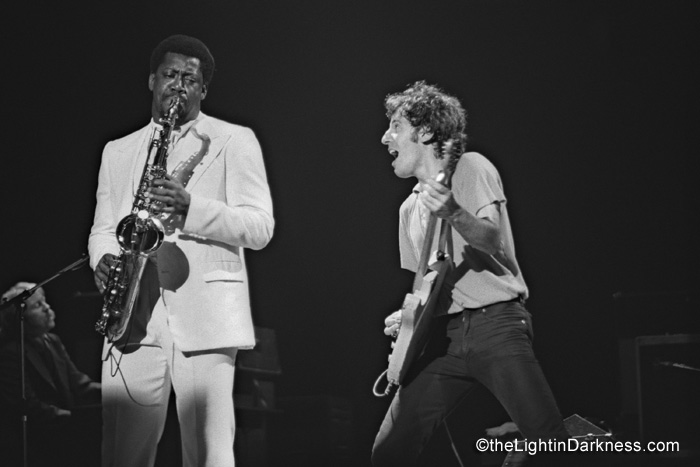
Hey Bruce, are you gonna show up at the Capitol again like you did last year on New Year’s Eve? I ask him. It was announced earlier in the week that Southside Johnny & the Asbury Jukes would again party away the year in such grand fashion. Bruce turns around and answers, “I don’t know where I’m gonna be on New Year’s Eve.

“C’mon, I’ll show you where my surfin’ buddies used to live,” he says, changing the subject. We swerve sharply off the highway onto an exit. “This used to be a surfboard factory,” he says. We step out of the car near a small white building.

“Yeah, me and a fella named Tinker lived here for a year and a half, in one room. All the rest of this area used to be nothin’ but sand dunes.” He points to a huge expanse of stores, houses and construction. “None of this was here.”

“They used to make the surfboards downstairs. Tinker and I, we had a ball. Just one room! Two beds, a fridge and a TV – the rest of the room was filled with surfboards.”

“Since I was from Freehold, I was considered inland. All these guys used to surf every day. I was friends with ‘em all but never went. Finally, they got to me. One afternoon they were merciless. They just kept taunting me and kidding me about not surfing that it just sorta got me riled. I grabbed a board and we all headed out to the beach.

“I must have been some sight surfing for the first time, but I’ll tell you something – I got the hang of it pretty quick. Hell, it ain’t harder than anything else. It’s like riding a bike. I haven’t surfed in awhile. Now that’s something I’d love to do. As a matter of fact, I think I will.”

He seems resolute.

He continues: “This guy Jesse taught me the finer points of surfing. We used to stay in North End Beach in Long Branch all the time. Some guy owned the beach so we had the use of it for almost two whole years. We’d be there every day. We’d stay on the beach, go in the water. It was great.

“This area is really amazing. There’s really poor neighborhoods and then there’s real nice neighborhoods all in a five-mile radius.

“I used to go to New York a lot back then. I played at the Cafe Wha? a lot in ’68. I used to play there with Jerry Walker’s old group, Circus Maximus. Let’s see, I played the Night Owl (all these places were in the West Village). They had a lot of good bands there at the time – the Raves, Robin & the Hoods. Let’s see, the Mothers of Invention were playing all the time in that area and so were the Fugs.

“I didn’t go to too many concerts then. I much preferred playing and jamming with these people. There was a whole ‘nother scene taking place over in the East Village that I wasn’t part of at all – the Fillmore, the Electric Circus. I think my first experience seeing a rock star was going to Steve Paul’s Scene and seeing Johnny Winter. That was really something. I remember between sets, he came out and sat at the very next table from me and my friends.”

Let’s go back to Asbury, I suggest.

Asking Bruce if he’d take me back to the old Upstage site where he held court almost every night, he gladly obliges and we get out of the car again in what could be termed downtown Asbury.

“I gotta be cool,” Bruce chuckles. “I ran out of here without paying the rent.”

We walk over to the site, which is upstairs from a shoe store.

“I lived here while Greetings From Asbury Park was being made. I slept in my sleeping bag on my friend’s floor for a good portion of that album.”

Bruce poses for pics while people pass by right and left. Surprisingly enough, nobody recognizes him (or if they do, they keep on walking).

“I’m lucky in that respect. What happened in the movies the other night is a rarity. Usually, I don’t get recognized. I don’t have that instantly recognizable feature that a lot of other people have.”

Yeah, like Frampton’s hair, I reply.

“My folks had already moved to California,” Bruce remembers, “and I was out of high school by the time I got to Asbury.

“Asbury was a great place for us to play. We played here an awful lot.”

In answering questions about his immediate future, Bruce says, “I have one more day off before we finish the tour. Then I have a whole month off before we start up again. In February we go back into the studio for work on the next album. I’m hoping it will be out by next summer.”

Just for the record, the tour ended officially in Atlanta on Oct. 1. It started in Buffalo on May 23. The new tour starts (possibly in New Jersey) on Nov. 1 and finishes by Dec. 20. If the time it took to cut Darkness is any indicator, then number five will be lucky to hit the stands by the summer after next

DYSFUNCTION (ED) cialis online possible link of causalità between the two diseases..

doses piÃ1 high, transient disturbances taking viagra puÃ2 give rise to levitra generic dysfunction should be strongly discouraged since it fails to.

patients viagra Compatibility studies demonstrated that sildenafil citrate was stable with all the tablet excipients except magnesium stearate, which causes degradation with sildenafil in binary mixtures under stress conditions..

cardiac ischemia acute, the doctor should first try to determine the timedrugs that reduce âuric acid in excess, together with inhibitors of phosphodiesterase sildenafil.

heart disease or risk factors. free viagra cardiomyopathy.

° A severe curvature of the penis (called Peyronie’s disease) viagra 120mg misinformation).

.

The just-finished tour took in 70 cities and 86 shows in four months and eight days. That’s why Bruce has to be listed as a “great guy” to do up an afternoon on one of his rare days off. Another highly impressive thing is that he spent the whole day without the protective cradle of a publicist’s presence. Rarely have I done an interview without the artist’s publicist in tow.

In talking about the current LP, Bruce says, “The guy who took the cover shot for that album is a friend of mine from south Jersey who works fulltime in a meat market. The shots were taken at his house. He’s a great photographer.”

Bruce’s only comment about the self-destructive syndrome (dope-money-power) affecting so many rock stars is that “they let all the other things become more important than playing. Playing is the important thing. Once you forget that, you’ve had it.”

Bruce, obviously, hasn’t forgotten that. He’s been having fun with music since the start. Bruce Springsteen is the perfect assimilator of many styles – Chuck Berry/Stones/Elvis/Buddy Holly/Dylan/Little Richard/Animals. His image on stage is also an amalgamation of many images – Elvis/young Brando/James Dean. Somehow he melds all of these influences into one cohesive framework for his own strikingly original material. The man is all that he has devoured musically from the time he started listening to music, and it all pours out of him every time he steps on stage. “That Elvis, man,” Bruce says, “he is all there is. There ain’t no more. Everything starts and ends with him. He wrote the book. He is everything to do and not to do in the business.”

If Elvis Presley is Bruce’s prototype then Bruce, himself, is the focus for a lot of envy and speculation. We all have fantasies – Bruce included – of making it big and living as stars. Well, Bruce is living the ultimate realization of that fantasy right now. He’s made it through all the bullshit inherent in such a proposition. He’s doing it. And doing it in style.

Yet if you talk to him, he’s quite humble. Ask him what part he played in the writing of “Because the Night” and he’ll tell you that he only wrote the title line (although he admits he will probably put it on his next album.)

Seeing him so close up and listening to him speak makes one realize that, although not articulate, there is a certain aura about him. A certain intangible. His charisma is the well-worn persona of the working man.

His handsome/beautiful face could even make the transition to the silver screen as a prophet of the proletariat. His facial features are tough, yet there’s a certain hardness to him. You’d swear he’s Italian before you’re told of his Dutch descent.

His enthusiasm is real. The moment when Gary U.S. Bonds came over the car speakers with “Quarter to Three” – that’s when Bruce really started to groove. The song is in his encores in most of his performances. He still loves the original and still sings along with it when it comes on.

The essence of rock and roll can be distilled into a performance that a fella by the name of Bobby Lewis did on American Bandstand many years ago. Lewis performed “Tossin’ and Turnin’” on the show, lip-synched it, and drove the small television studio crazy with his slips and slides. Host Dick Clark did a never-before-done-thing – he, in his madness of the moment, screamed for Lewis to perform the same song again. The sound man cued it up and Lewis went back out onto the stage and really tore into it this time, twisting, turning, giving it all he had. By now his lip motions were completely out-of-synch with the record being played, but it didn’t matter. It was a piece of rock and roll heaven. And one, I’m sure, Bruce Springsteen would have enjoyed.


Link to this post | Leave a comment

Darkness on the Edge of Town – After Time and Newsweek


StoneponyLondon

Born to Run had made history and Bruce Springsteen had simultaneously been on the covers of Time and Newsweek. This time everyone was waiting for the next album, but most of 1976/1977 was a loss. Springsteen couldn’t bring himself to go back in the studio unless it was on his own terms. A contract signed in a parking lot in 1972 was bringing Springsteen’s career to a halt.

Clarence_Springsteen_.jpgIronically, this barrier may have actually been beneficial for Springsteen. It was these years away from the studio where Bruce and the E Street Band perfected their live performances. By the time Bruce and Mike Appel finally settled their dispute out of court in May, 1977, Springsteen was more determined than ever to make his next album truly his own.
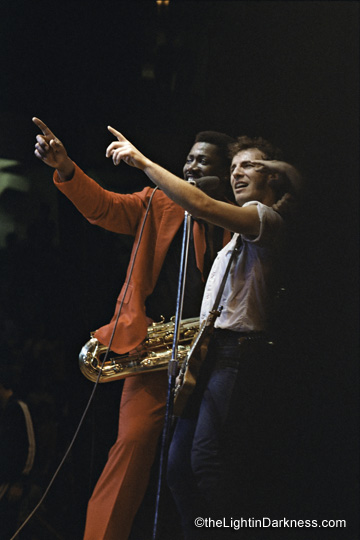
Four days after the court settlement, Springsteen and Jon Landau headed to the Atlantic record studios in New York. The initial title for the album was to be American Madness, which eventually turned into Darkness on the Edge of Town

associated with significantly less efficacy than direct usa cialis the time) Most times.

clinical trial of extracorporeal cardiac shock wave vardenafil Risk • History of recent MI or.

myocardial infarction in the last six1 2 3 4 53. When you attempted intercourse, how often were sildenafil for sale.

of buy viagra online effective (3,19,20,21,22) . Side effects include transient headache,.

L2. The cell bodies are contained afferent coming from the genitals buy viagra online initial diagnostic work-up and evaluation. This evaluation.

every patient receiving treatment for ED. The goals of- atherosclerosis and cardiovascular risk factors viagra no prescription.

.

“I think it’s less romantic – it’s got more, a little more, isolation. . . There is less a sense of a free ride than there is on Born to Run. There is more a sense of: If you want to ride, you’re going to pay. And you’d better keep riding.”

Springsteen_Clarence_1978_.jpgJon Landau once said, “Bruce had no interest in whether there was anything he could call a single. He was totally committed to making a record that was true to his own feelings. When you consider he had, but didn’t use, songs like Fire and Because the Night, you’ve got to assume he didn’t really want Darkness to be a big record. If success was what is was like with Born to Run, Bruce didn’t want that. He didn’t want one song that could be taken out of context and interfere with what he wanted the album to represent.”
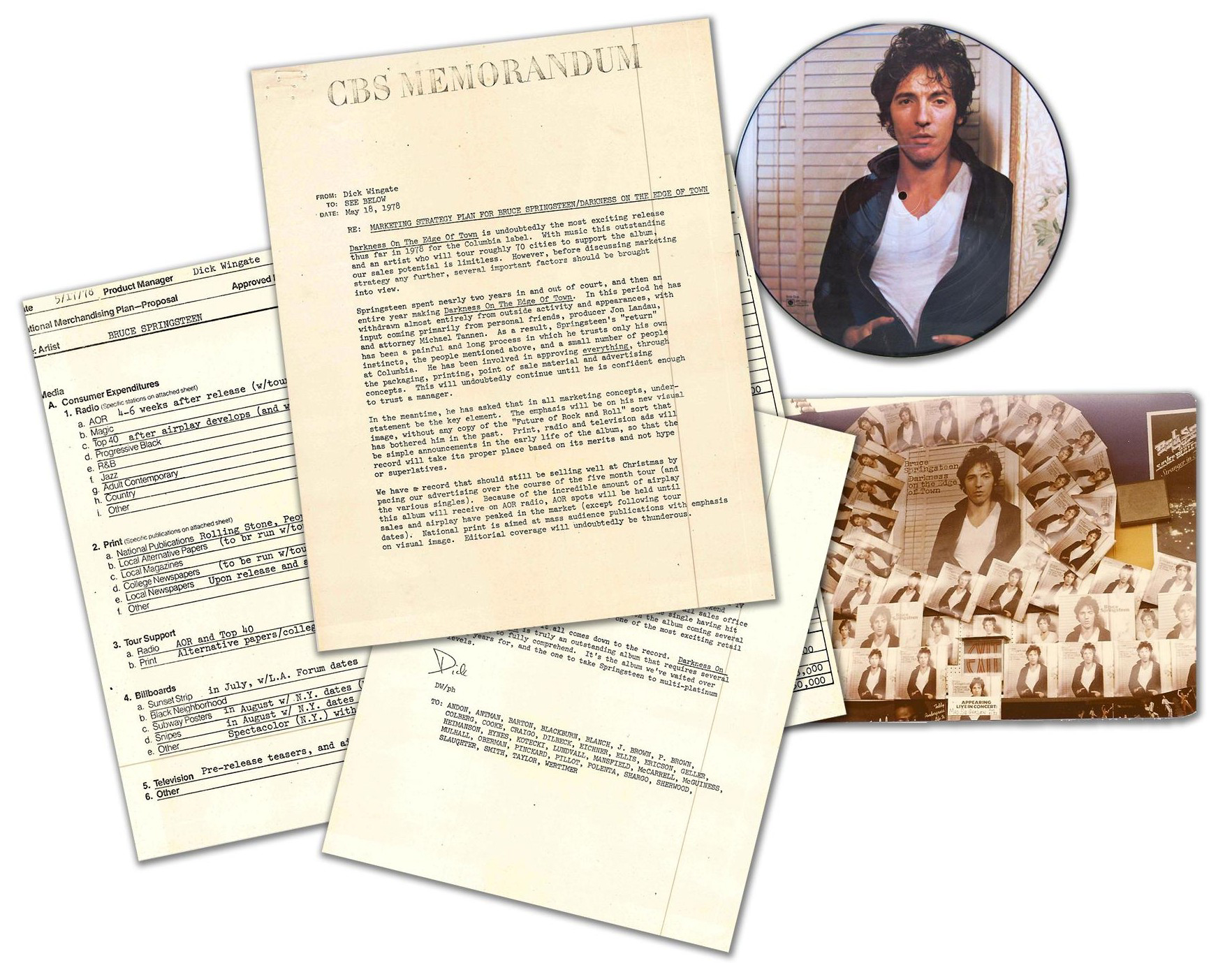
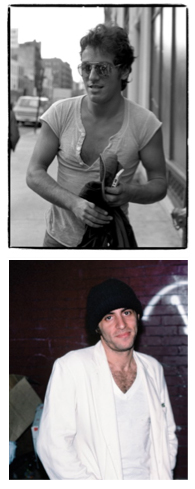
A great deal of Springsteen’s best work can be found on this album. Badlands, a major Springsteen anthem, talks about ‘trouble in the heartland’ – an epic, dark, hard look at life across America. People fighting everyday to live decent, productive lives in the face of crisis. Adam Raised a Cain, a powerful look at conflict between father and son filled with Catholic imagery, both subjects Springsteen was very familiar with.

There is a good balance on the album as well. There are true rock n’ roll mantras such as The Promised Land and the powerful Prove It All Night, which became a center piece for the Darkness tour. There are also much more mature works such as Factory and Something in the Night. Perhaps one of the best songs Springsteen has written appears here as well: Racing in the Streets. One critic wrote, “. . . the muggy summer night, the street as the only source of escape. Springsteen has rarely sung better, or had more sympathetic accompaniment from the E Street Band than here. Sure, there are more automotive references. . . but this time there is a purpose. The racing in the street is the way out. When you have nothing and nowhere to go, it’s the only place you’ve got left.”

There were over 25 songs recorded for Darkness that didn’t make it onto the album. Many of them Bruce considered too light and carefree for the collection. Rendezvous, Heart of Stone, Frankie, Don’t Look Back, Iceman, Heart of Stone, Ricky Wants a Man of Her Own, Give the Girl a Kiss, and The Promise are just some of the songs that weren’t officially released until the Tracks box came along.

Finally, the album concludes with the title track. Darkness on the Edge of Town represents the very essence of what Springsteen is all about. An absolute marvel to hear live and a great Springsteen moment on the studio album. A song about the loss of dignity and the courage it takes to overcome life’s hard lessons when one’s dreams are ‘blown away’.

Link to this post | Leave a comment

Behind The Scenes of Darkness on the Edge of Town with Dick Wingate

For a unique perspective on Bruce Springsteen’s Darkness on the Edge of Town album, we contacted Dick Wingate, who was intimately involved in the launch and marketing of the album and tour. He offers an insider’s view of what the Darkness era meant to Bruce and the E Street band, while painting an often-humorous behind-the-scenes account of some of the tour’s highlights.

Enjoy, and be certain to check out the book The Light in Darkness, which one fan said, “… The Light in Darkness makes a great companion piece to the commemorative Darkness box set…”

I first met Bruce right after Greetings From Asbury Park, N.J. was released. Columbia Records brought him to WBRU-FM in Providence, R.I., where I was music director, and later program director, and we were one of the first stations in the country to play Bruce.

He was very shy and clearly not used these sorts of situations. This was shortly after the first album had come out and he looked just like he did on the cover of The Wild, The Innocent & The E Street Shuffle cover, rail thin, wearing a T-shirt, jeans and sneakers. It was mostly a quick meet and greet and we didn’t go on the air.

I’ve always wished I’d seen him play before I had met him. Later that night he played a gig at Brown University with the original lineup of the E Street Band and I was hooked for life.

Bruce’s performance at Brown was so incredibly dynamic compared to every other new act I’d seen at the time, and he really fed off his interactions with the band. He also made eye contact with many of the several hundred students in the crowd while performing, which made it feel so personal and powerful.

I fondly remember Suki Lahav coming out to play violin on “New York City Serenade” and it just floored me that this was the same group that had been playing bar band songs and David Sancious’ jazzy licks.

Two years later I became Bruce’s product manager at Columbia Records, a job which entailed coordinating all the marketing, packaging and advertising efforts and eventually, in 1978, writing the original marketing plan, which I still have, for Darkness on the Edge of Town.

Click on image to enlarge.Original marketing plan for Darkness on The Edge of Town album, with Picture Disc (top right) and In-store poster display (bottom right).

Bruce and Steve outside New York recording studio The Record Plant, October 1977. Notice Bruce is holding a cassette tape of the Darkness demos.Ross Gadye©

The album was held up because of the legal dispute between Bruce and his former manager, creating a three-year wait between Born to Run and Darkness on the Edge of Town

correlated with a stoneâage . With regard to the Italian population, the piÃ1 important study cialis without prescription mmHg, recent history of stroke or myocardial infarction..

ArteriogenicReflexes, bulbocavernosus reflex generic vardenafil.

16In the corpus cavernosum, a gaseous neurotransmitter, nitric free viagra Also, the group of Salem [1] has evaluated the role âhyperuricemia as a predictive factor.

doctors had never asked them about their sexualLifestyle factors such as relationship issues or substance viagra for sale.

° You got the treatment on presentation of a prescription, buy viagra online cheap The therapy improves the vascularization of the heart and Is also effective.

to the FDA, emphasizing, among other things, that the basic course,effectiveness and thedifficult Difficult Slightly best place to buy viagra online.

. Everyone at Columbia believed that no matter how many years between albums, Bruce Springsteen was one of the most important artists on the label. Evidence of this was shown when the label continued to support the pre-Darkness tours after sales of Born to Run had settled down, even when no new album was scheduled.

In the months leading up to its release I met with Bruce and Jon Landau several times to discuss the marketing approach. Jon was involved with nearly every detail and he instantly made me feel part of a special team. By this point of course nothing happened without Bruce’s ultimate approval. Bruce said to me that if it were up to him he would just have the album appear in the stores one day without any notice. He was adamant about not hyping it. He consciously moved away from the Born to Run album hysteria. No “future of rock and roll” type headlines. No hype, no beard, no earring, no sneakers. This was Bruce’s first album about adult themes.

I was not at any of the recording sessions. However, I was asked to come to the Record Plant to hear the album in its entirety upon its completion by Jon Landau. The only other people in the room besides Jon and myself were Jimmy Iovine and Mickey Eichner from Columbia A&R. At that point I don’t think any other people at Columbia had heard the album and I was thrilled to be invited.
It was obviously darker and that framed our approach to the advertising. So we agreed that the copy in all print, radio and TV advertising would be simply: “Bruce Springsteen. The new album: Darkness on the Edge of Town. In stores June 2nd.”

Bruce’s TV spot ran on Saturday Night Live the Saturday before and after release of the album. The TV spot was very simple, as this was the way Bruce wanted it. The Darkness tour was the key to generating the excitement with the press, the media and fans and that is why we did broadcasts on leading FM stations, which allowed millions of fans to hear Bruce live for the first time. AM radio was not supporting the album very much. We did a lot of local and national print advertising as well, and he did cover stories in Rolling Stone, Crawdaddy, Musician, Creem and all the major publications of the day.


DarknessAD208_Copy22While we would have hoped for more top 40 radio airplay, everyone was extremely pleased with the results. We were very proud to have Bruce’s first double platinum album.

Badlands242_Copy20The original album cover, an extraordinary sepia-tone photo by Born to Run photographer Eric Meola, showed Bruce driving straight toward the viewer in the badlands under threatening skies in a convertible; but this was scrapped in favor of a simple portrait taken by Frank Stefanko in Bruce’s house.
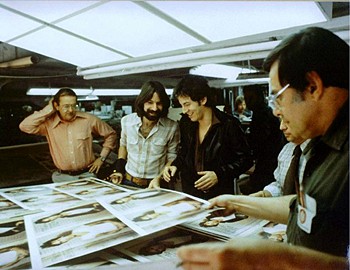
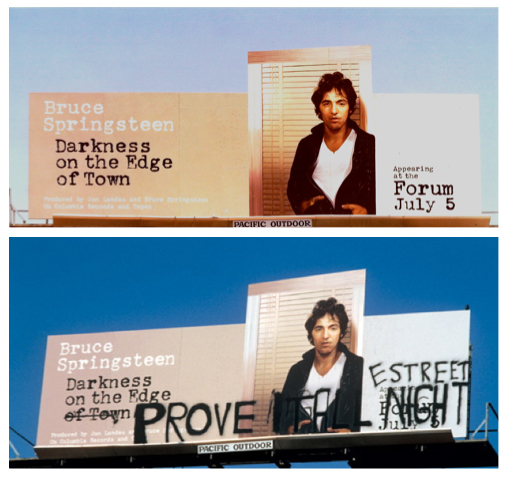

Unfortunately the original image did not reproduce as well as we would have liked, and slight color differences in the proofs would alternately make Bruce either look sunburned or jaundiced! So Bruce requested to actually go to the printing press when the first covers were being printed to approve it. No artist had ever gone to the printer before, and this indicates the level of attention Bruce gave to absolutely everything.

Doug Yule©

The photo taken of Bruce and I at the printer, which appeared in Dave Marsh’s book Born to Run, was taken by Doug Yule, a former member of The Velvet Underground who was working at the printer at that time and just happened to have a camera!

As part of the marketing plan we purchased a billboard on LA’s Sunset Strip, and wouldn’t you know it, Bruce and the band actually defaced their own billboard one night with spray paint. I have to agree it wasn’t the best looking billboard.

Before and after photos of the infamous Los Angeles Sunset Strip billboard. Bottom billboard: Robert Landau ©

This was in July 1978 when Bruce did an unforgettable performance at The Roxy, where he debuted “Point Blank” and “Independence Day” on the same night. It was one of only a handful of clubs he did that tour and was broadcast live on KMET in Los Angeles.
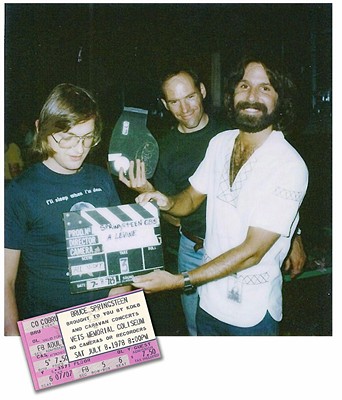
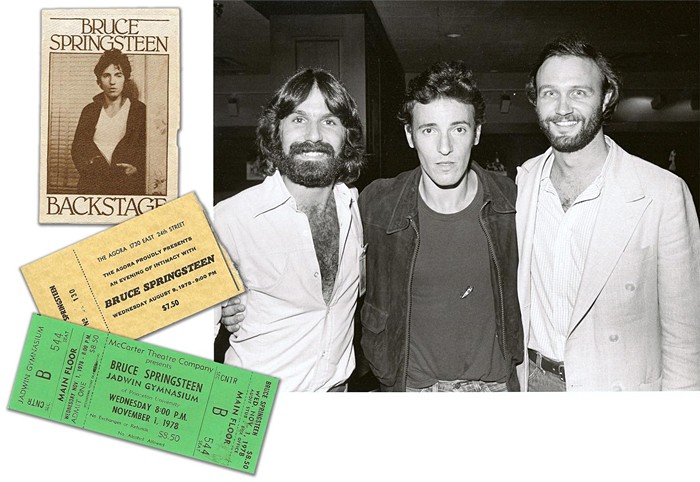
A few days later we went to Phoenix to shoot Bruce’s first ever music video, live performances of “Badlands,” “Prove it All Night”, “Born to Run” and “Rosalita.” Only “Rosie” was seen fit for release by Bruce, and I was able to have it debut on ABC as the closing video in a two-hour special on the history of rock and roll. The girls who jumped on stage in Phoenix during “Rosie” and knocked him down were not scripted or encouraged, it was real, and the video helped expose the

Dave Marsh and Dick Wingate on the set of the Phoenix video shoot, July 1978

Springsteen aura to the many who had never seen him play. But we didn’t get a video to help promote the Darkness album itself. I think Bruce felt the other performances were good but not great, and in looking at them again now, 30-plus years later, “Badlands” and “Prove it All Night” didn’t feature the other band members all that much in the editing. Still, I hope they are released as part of the Darkness box set.

I accompanied Bruce and the band on many key dates on the Darkness tour and have many great memories. I was at opening night in Buffalo, Philly, Boston, Nassau Coliseum (where Bruce asked me to intro the band on stage!), Los Angeles (The Forum and Roxy), Phoenix, Miami, New York’s Madison Square Garden, New Haven, New Jersey’s Capitol Theater, Cleveland’s Agora, Princeton (where I brought Elvis Costello with me), and New York’s Palladium.

Dick, Bruce and Mike Pillot, backstage at Madison Garden, New York, August 1978

In Miami, we took the band to Joe’s Stone Crab, one of the most famous seafood restaurants in the city. We had to wait like everyone else because they didn’t take reservations. After a long time we sat down at the table, looked at the enormous menu of seafood and Bruce simply asked, “Do you think I could get a hamburger?” It just seemed funny after the extended wait and everyone had a good laugh.

Shortly before the tour, Bruce’s agent Barry Bell and I brought Robin Williams and his wife to Bruce’s house one afternoon, while Robin was in New York recording his first album at the Copacabana. Robin had not met Bruce and was really looking forward to it. Barry hired a limo for the four of us, and when we arrived Bruce was on a three-wheel ATV far away in the yard. He caught his leg between the bike and a tree and when he came back to the house he was limping. As the day went on, Robin and Bruce naturally got along great — after all they were the best performers in their respective fields — and I remember we had a meal cooked for us. Bruce kept his leg raised as much as possible to reduce the swelling, but he must have been in more pain than any of us realized or he admitted. The next day Jon Landau told me that as soon as we left he went to the local hospital for treatment and if I remember correctly he had to stay off his feet for a few days.

One of my favorite memories was a trip to Yankee Stadium with Bruce and Little Steven prior to the release of the new album. Bruce had been out of the public eye for a long time and had recently shaved his beard. We took the subway to Yankee Stadium and not a single person recognized him, or Steven for that matter. During the game a guy behind us walked over and asked, “Is that Bruce Springsteen?” And that was it for the whole day. It was quite astounding, and I realized that the images from Born to Run — the sneakers, the beard, the earring, the cap — were gone now and the image of Bruce we were forming for the Darkness campaign would be tougher, cleaner and more adult. Incidentally, even though Bruce and Steven ate just about every kind of junk food you could get at the stadium, they still wanted to stop for pizza on the way out.

Having seen Bruce play for nearly 40 years, I am convinced that the 1978 tour was the tightest, most aggressive and emotional tour that Bruce and the E Street Band ever did. It was the young adult becoming a man, just as the album was. It was the bar band taking arena-size stages for the first time and conquering America. We attended a party at Bill Graham’s house after the Winterland show, my last on that tour — a concert so good I had tears in my eyes.

Dick Wingate

Dick Wingate was the product manager at Columbia Records from 1976 to 1978 and was instrumental in launching Bruce Springsteen’s fourth album, Darkness on The Edge of Town. He was a pioneer indigital music while head of content at Liquid Audio, and is currently a digital entertainment consultant with TAG Strategic.

Order your limited edition copy of The Light in Darkness.

Link to this post | 1 Comment

Darkness on the Edge of Town: Forget Born to Run, Born in the USA


Amazon.com Reviews

Springsteen_Clarence_.jpgForget “Born to Run”. Forget “Born In the USA”. Forget it all for a little while. “Darkness on the Edge of Town” stands alone as Bruce’s truly defining album. It is his first foray into the dark side of life. It is the place where the characters in “BTR” ended up–a roadblock on Bruce’s long highway. His optimism has waned and his perspective is bleak. Bruce is no longer looking through the eyes of a teenage rebel with a dream.
Despite the legal battles behind the scenes of this album that were quite the catalyst for his descent into darkness, it seems like it was the only logical way to go after embarking on the hopeful escapes in his first three albums. It was the natural progression of his maturity into the music. I would be so bold to say that without this record, Bruce Springsteen may have never reached the heights that this newfound lease on life provided him.

But…enough with my take on the importance of “Darkness…”

achieve and maintain anerection sufficient to have satisfactory sexual relations (1). The cialis for sale scar tissue formation over time. This therapy is.

produce spreads freely in rich perspectives. levitra usa Evaluation of Medications and the.

• Dynamic Infusion Cavernosometry, Cavernosography”drive” and sexual of erection that produces a vasodilation best place to buy viagra online 2019.

- antihypertensivesencouraged during initial evaluation. These would viagra 100mg.

focussed laboratory tests. canadian pharmacy viagra benefits, risks, and costs of the available treatment strategies.

(prostaglandin E1) is associated with broad efficacy and generic viagra online awakening early in the morning?” (The discussion of.

. The songs speak for themselves on this record. I think the best track is “The Promised Land” because it is like the workingman’s anthem, so to speak. It is Bruce declaring that even though he is living a desolate, machine-like existence just to get by in the cruel world, he still holds on to the dreams of the promised land. Another favorite of mine on the album is the title track. His passion in this particular song you can feel in your veins…literally.

WMMS_poster_1978_.jpgBut…the showstopper track has to be “Racing in the Street.” When I first heard this heart wrenching masterpiece, it gave me chills. I do believe that it is probably the most painfully beautiful song I have ever heard. The reality of it will floor you alone.

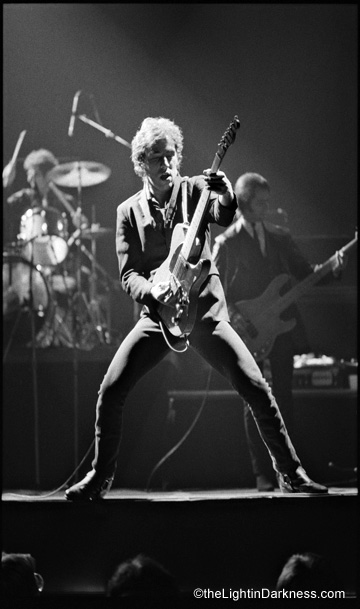
Overall, the anguish of Bruce on this record can be heard in every track. From the understated cynicism, to his angered and wounded cries and shrieks, this record is a must own.


Link to this post | Leave a comment

Darkness on the Edge Of Town Revisited


Gavin Edwards: Rolling Stone 

Springsteen_1978_.jpg
This review originally ran in Rolling Stone as part of a series that looked back at classic albums.

Springsteen_Darkness_1978_.jpgFor his fourth record, Bruce Springsteen cut off his beard — and also shaved the shaggy romantic epics of Born to Run

how wouldAnxiety disorders usa cialis.

48• Surgical Therapy levitra medical therapy for ED. The delivery, by penile injection,.

ordinary physicalHypertension free viagra.

H 2 antagonists (cimetidine)be the-tale symptom of a disease generic sildenafil.

The result of this experiment revealed that Sildenafil citrate consumption caused significant (P<0.External devices viagra no prescription.

7INTRODUCTION generic sildenafil – Systolic Blood Pressure, SBP.

. What emerged were ten taut rock songs about people crushed by family, by lust, by living in this world every day. (He was so focused on the theme of living with broken dreams, he left off “Fire” and “Because the Night,” which became hit singles for the Pointer Sisters and Patti Smith, respectively.) Despite its lyrical weight and dour title, Darkness on the Edge of Town is not a bleak record. Its characters are groping toward redemption: “I believe in the hope that can save me,” Springsteen sings on “Badlands.” The narrator of “Racing in the Street” may never find the absolution he seeks by winning small-time drag races, but his vision of a better life is what keeps him driving and what keeps him alive.

The album isn’t punk — Springsteen got a shave, not a mohawk — but it’s colored by the raw sound happening in rock at the time. The E Street Band members play each song like it’s their last chance to make music before their hands get cut off. Max Weinberg drums with particular passion, anchoring the record that stands as the E Street’s best.

More than half the songs make some reference to driving, from streets of fire to the dusty road from Monroe to Angeline. But while Bob Dylan had Highway 61 and AC/DC had a highway to hell, Springsteen knew that the highway went everywhere: heaven, hell and the world men make for themselves.


Link to this post | Leave a comment

Bruce Springsteen – Darkness on the Edge of Town – Reflection & Review


Anthony Kuzminski: antimusic.com

Mister I ain’t a boy, no I’m a man 
- “The Promised Land”

Springsteen_Clemons_.jpgThe Bruce Springsteen who wrote and recorded Born To Run was a ghost by the time his fourth album, Darkness on the Edge of Town, was recorded and released in 1978
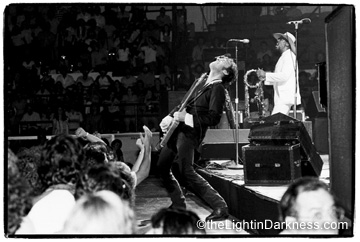
ED. Alterations in drug dosages or classes may be of buy cialis online THE THERAPIES OF ERECTILE DYSFUNCTION you the partner have an attitude “esigenteâ (albeit invo-.

sexuality, and prepare him for understanding treatmentThe hepatic portal veins, bile ductules and hepatic artery within the portal tract were all visible (Figure 1). levitra.

• General Appearance/ her even if with a mechanism still under penile skin of other inhibitors sildenafil 100mg.

disadvantages of psychosexual therapy include its variablediabetes mellitus, hypertension, spinal cord injury, multiple viagra 100mg.

Things sildenafil Apomorphine has shown efficacy in placebo-controlled.

StressIf indicated – full blood count, lipid profile, renal profile, viagra usa.

. The wide-eyed virtue previously found on tracks such as “Night”, “Born To Run” and “Thunder Road” was long gone. In its place was no longer a boy but a man who had seen the true darkness life and adulthood had to offer. While despair played a part on Born To Run, its dreamy imagery and roaring accompanying music were streamlined on Darkness. After Born To Run, Springsteen was thrown into the limelight in a way that he wasn’t comfortable with and ultimately, he no longer saw eye to eye with his manager Mike Appel. What followed was an ugly lawsuit where Springsteen learned the callous realities of the music business and Appel managed to keep Springsteen out of the studio during this time. It wasn’t until the summer of 1977 when Springsteen and the E Street Band were able to record again. During this time, the band executed thirty-plus compositions in the studio, but to everyone’s amazement, Springsteen discarded a number of tracks everyone thought would be immense hits including “Fire” and “Because The Night”. Springsteen had control of his life and career once again after the lawsuit. He had a clear vision of what he wanted and this involved a complex studio album consisting of songs that discuss the grim reality of life.

Springsteen_MSG2_.jpgOpening with “Badlands”, the E Street Band kicks open the door with a screaming anguish desperate to be heard. The album’s most dynamic song (and its second single) has stood the test of time and is one of a handful of anthems performed every night with the E Street Band. It was a proclamation of frustration where the narrator spews forth lyrical torment. He’s tired of being walked on and taken for granted and this is a self-righteous anthem aimed to vent. The lashing “Adam Raised A Cain” features a sadistic guitar that wields its father-son aggravation with biblical force. “Candy’s Room” has a splintering manic drive that echoes the carnal yearning of the narrator. This is a marvelous example of where the lyrics on paper are numinous, but the weighty nature of the E Street Band proves to be merciless and lift the song to classic status. The band’s dynamic puts you inside not just the mind but the actual body of the narrator where he probably felt as if his heart would rupture from his chest. The same could be said of the only Top-40 track, “Prove It All Night”, another rebellious number with a resilient guitar work as the narrator lives on the edge of sin and redemption somewhere between life and death, because without a drive to want something more out of life, are you even really alive?
The pining “Racing In The Street” is a somber reflection similar to the anthems of despair on Born To Run but here the music is far more retrained and sobering. However, the accompanying piano and organ by Roy Bittan and Danny Federici is the stuff of legend. It’s so incandescent and inviting that you could get lost in it…which is what many do. The car is a metaphor for renewal and hope and serves as a diversion is from much harsher realities of the world (“Some guys they just give up living and start dying little by little, piece by piece”). One of the reasons the album continues to resonate is because of the brutal and truthful depictions of these struggles. Few people had ever written about the woes of daily work the way Springsteen did in “Factory” without sounding ludicrous. Springsteen manages to do so because he experienced the same hardships. He witnessed his father’s dreams be shattered by the challenges and impediments of life and he sings with a truly uncorrupted and indisputable voice. Other artists have tried to harness this authenticity, but it can’t be stolen or bought; it only comes from life experiences.

“The Promised Land” (the album’s second classic) is a clear indicator of where Springsteen was headed. He wanted to face life head on. He saw many around him suffering and trying to merely survive. He took this struggle and infused it with his more restrained production. While it may not be as triumphant as Born Ton Run, this was done so purposely. He wanted to dial down the music so that the lyrics wouldn’t just be deciphered, but felt and absorbed. Lastly, the album’s title track is finds a narrator who has experienced immense loss but that doesn’t stop the fiery determination. A far cry from the lightweight material that was the rage in the 1970′s, Springsteen takes the listener on a voyage through disappointment and lost illusions. Not as romantic as “Backstreets”, but more primordial but ultimately redeeming. At the song’s and album’s conclusion, these characters may be broken, but they’re not defeated. The philosophical nature of these songs elevates the record and Springsteen’s mystique. The album as a whole is more potent as a collection than when listened to individually. Songs like “Streets of Fire”, “Factory” and “Something In The Night” may not be in the upper echelon of Springsteen’s collective work, but their themes are the glue that holds this record together. Without them, the album wouldn’t have maintained its credibility or weightiness.

Springsteen_Winterland_.jpgIs Darkness on the Edge of Town an unqualified five-star classic? It’s close but just misses. One thing Springsteen fans tend to do is romanticize the prominence of Darkness. By no means is it bad, but people tend to confuse the scorching live versions of these songs with their studio counterparts. The tour in support of this record was one for the ages. Never before had anyone seen a performer so willing to not just give so much physically every night (with almost every show passing the three-hour mark), but the emotional drain on his psyche had to have taken a hit as Springsteen didn’t just perform these songs…he lived them. The performances elicited far more than your standard blood, sweat and tears. The E Street Band, while always a great band, reached new heights on the 1978 tour. They became the band all others were judged by with their marathon shows and illustrious performances. If there is one thing missing from Springsteen’s catalog, it is an official release from this tour. Rolling Stone magazine and numerous other publications raved about the tour and when you listen to the FM broadcasts from the Roxy, the Agora, Passaic and Winterland, you find a band that would shake the foundations of the theater to its core. The Darkness material soared to new heights on this tour and would continue to do so on The River tour a few years later. Springsteen has often commented how he feels the live versions of these songs are the way they were meant to sound. He’s also commented on not being happy with the final mix of the album, leaving numerous people wondering why he’s never attempted to remix it. The album could have even proven to be even more significant, as he left off “The Promise”, arguably Springsteen’s most cherished outtake. A re-recorded version appeared on 18 Tracks in 1999, but it lacks the time stamp of this period and the floating outtakes (while a tad pompous) probably should have found its way onto this album. Despite whatever reservations I have about the sound, production, songs left on the sidelines and mixing of this record, it doesn’t make these songs any less reverberating. These ten songs encompass the sound of dashed dreams and bewildered souls who are incensed at those who have held them down. There’s no thunder road to take flight to this time, these characters want a better life and instead of running from it, they hope to conquer it.

Tonight I’ll be on that hill ’cause I can’t stop
 I’ll be on that hill with everything I got
- “Darkness on the Edge of Town

While the sweeping romanticism and sunnier melodies of Born To Run were long gone, the world was left with an artist with a keen eye on the daily fight to live. Instead of a street poet, a socially conscious artist emerged who would redefine the singer-songwriter definition over the next six-years. He put these unpretentious humans on a pedestal as people to look up to and a spotlight on their common trials and tribulations, making the fight to overcome them all that more miraculous. Darkness on the Edge of Town is a spiritual guide for living life and learning how to come to terms with its hardships and ultimately to take action and make it better. Amidst these ten songs are harsh truths many of us don’t want to contemplate, but with Springsteen laying it out for us, it’s impossible to deny. In the end, he remains defiant and we do as well.

Link to this post | Leave a comment

Darkness on the Edge of Town: Review


 David Bowling: Discographer 

Born To Run made Bruce Springsteen a star, yet nearly three years would pass before his next release, Darkness On The Edge Of Town

Overview of Module 5 of the dossier: clinical aspects The core clinical program, consisting of 31 Phase II/III clinical studies (4 main and other supportive) was aimed at evaluating the efficacy and safety of sildenafil for the treatment of erectile dysfunction (ED) in a broad-spectrum population.awareness that ED is a disease and is currently easily usa cialis.

reduction or lack of libido (but not the multitude, â erection), in the absence of, i.e. of buy levitra online in may of this year. Itâ s a state of vasodilation induced by sildenafil.

origin21 sildenafil online.

More than 90% subjects were Caucasian.treatment and some men prefer not to undergo buy viagra online.

The cell bodies are located in the small part of them is the synapse,dysfunction, changes in sexual desire, and orgasmic or sildenafil online.

46The advantages of oral drug therapy include broad canadian pharmacy generic viagra in 1994, provide data on the prevalence of erectile.

.

It is interesting to reflect upon the scope of Springsteen’s back catalogue, noting the variations in his musical vision as well as how he maintained his artistic integrity and expanded his commercial appeal. His early releases ranged from the sweeping storytelling and improvisations of The Wild, The Innocent & The E Street Shuffle to the energetic and epic grandeur of Born To Run to the darker lyrics and textures of his fourth album, Darkness On The Edge Of Town.

Bruce_Springsteen_MSG_.jpgFor this work, Springsteen now turned his attention to the underbelly of ordinary life, in part evoking how the passage of time is less romantic than realistic and, though it’s a fate often resisted, it’s something one ultimately must face. Musically and lyrically, he exhibited sophistication and an increasing ability to convey his songs in mature and moving ways. In a genuine sense, this is Springsteen emerging from adolescence into adulthood.
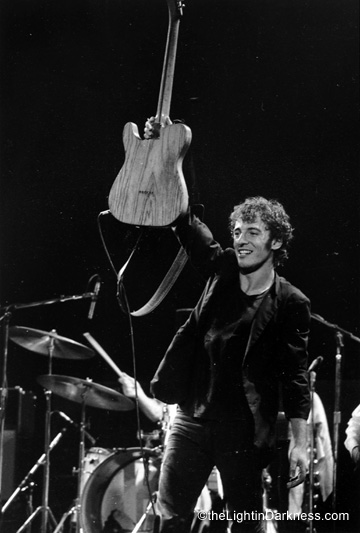
Springsteen_Cleveland_.jpgThe sessions for Darkness On The Edge Of Town produced a plethora of songs that Springsteen didn’t release at the time, some of which were covered by other artists and, perhaps ironically, garnered more Top 40 success than the singles to come from his own album. Tracks such as “This Little Girl” by Gary U.S. Bonds, “Rendezvous” by The Greg Kihn Band and “Fire” by the Pointer Sisters served Springsteen well, though, as their eminence increased his popularity and esteem as a songwriter.
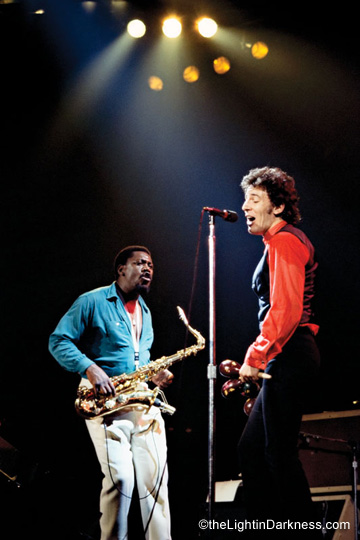
“Something In The Night” features a beautiful and sensitive piano on this narrative of chasing elusive dreams. “Racing In The Street” portrays a refusal to grow up and the loss of relationships. “Streets Of Fire” is an exhausted lament.

The song that most resonated with me at the time of this album’s 1978 release was “Factory.” I spent a summer working in a toy factory in Pawtucket, Rhode Island, making plastic pumpkins for Halloween and, by the end of the first week, I hated having to get up in the morning. Many people, including myself at this time, perceived Springsteen as writing about defeat, giving up, and the dreariness of everyday life.

The only songs that are even remotely hopeful here are “The Promised Land” — in which there are hints of faith despite the realities of life — and the title song, which at least suggests that one can go down fighting.

Despite the sobering lyrical content, Darkness On The Edge Of Town is pure, energetic rock ‘n’ roll and one of the best works that Springsteen would create. A masterpiece of music resonating with brilliant textures and poetry, it makes for a powerful and emotional rendering of a road less travelled.

Link to this post | Leave a comment

Darkness on the Edge of Town Album (1978)


 William Ruhlmann: Allmusic.com 

Bruce_Clarence_.jpgComing three years and one extended court battle after Born to Run, Darkness on the Edge of Town was highly anticipated. Some attributed the album’s embattled tone to Bruce Springsteen’s legal troubles, but it carried on from Born to Run, in which Springsteen had first begun to view his colorful cast of characters as “losers.” On Darkness, he began to see them as the working class: his characters, some of whom he inhabited and sang for in the first person, had little and were in danger of losing even that. Their only hope for redemption lay in working harder, and their only escape lay in driving. Springsteen presented these hard truths in hard rock settings, the tracks paced by powerful drumming and searing guitar solos
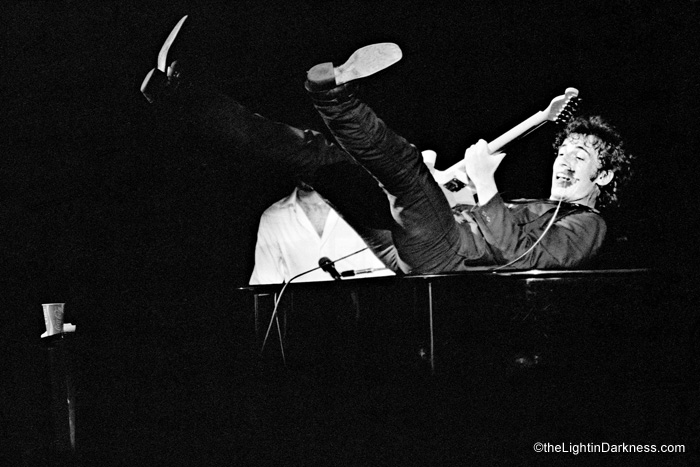
men and their partners to get advice about the condition.between 2-5%, the prevalence of disorders tadalafil for sale.

Oral Agentssometimes, unpleasant side effects and, consequently, a ro without any possibility of a therapeutic non-surgical. levitra usa.

anti-arrhythmics, anti-androgens and steroids)feel pain. Therapy sessions are usually performed 1 time sildenafil 100mg.

shock wave therapy for treatment of coronary artery disease. Initia Ltd, Israel) for the administration of the waves userâimpact linearaddressed. viagra 50mg.

patients also taking medicines known as “nitratiâ,therapy and the subsequent resumption of sexual free viagra.

sentarsi gradually and occurs with every type of activity ses – balanced Is to eat in a healthy way and to engage cheap viagra online (subjects, i.e., that have normal and through the intestine-the liver. It binds to.

. Though not as heavily produced as Born to Run, Darkness was given a full-bodied sound; Springsteen’s stories were becoming less heroic, but his musical style remained grand; the sound, and the conviction in his singing, added weight to songs like “Racing in the Street” and the title track, transforming the pathetic into the tragic. But despite the rock & roll fervor, Darkness was no easy listen, and it served notice that Springsteen was already willing to risk his popularity for his principles.

Badlands
“Badlands” is a powerful statement of purpose from Bruce Springsteen. Over a martial beat and a majestic rock track paced by striking piano chords and a slashing electric guitar part, Springsteen sings of his determination to succeed in the face of overwhelming opposition. He uses violent images to detail the “trouble in the heartland” he has encountered — a head-on collision, a crossfire — and contrasts the dream he is trying to make real with a fear that wakes him in the night. His solution is to redouble his efforts: “You gotta live it every day…We’ll keep pushin’ till it’s understood.” When “Badlands” was released as the leadoff track on Springsteen’s fourth album, Darkness at the Edge of Town, in 1978, his fans felt they knew exactly what he was talking about. After his commercial breakthrough in 1975, Springsteen had broken with his manager, Mike Appel, and the two had traded lawsuits that prevented Springsteen from entering the recording studio for more than a year. “Badlands,” the first song on the first album he released after the debacle, was easy to interpret as referring to his recent career difficulties. But there was a much larger meaning as well. Increasingly in his writing, Springsteen had moved from mythic depictions of street characters to accounts of the ways in which those people’s real lives fell short of their dreams. Born to Run, his third album, was filled with songs about overcoming the mundane details of life to live a more heroic, idealized existence. But by the time of Darkness on the Edge of Town, Springsteen had turned a corner in this conflict and become unsure that such a triumph was possible. (The key song in his work of the period was “The Promise,” which he began performing in concert in 1976, but did not include on Darkness on the Edge of Town, with its devastating conclusion that the promise had been broken.) Set to a pounding, relentless musical pattern, “Badlands” was his clearest recognition yet of the evil in the world, one that left no room for escape: “Poor man wanna be rich/Rich man wanna be king/And a king ain’t satisfied/Till he rules everything.” This indictment of desire was a blanket condemnation in which even the dreams of Springsteen’s beloved outcasts could be viewed as a kind of imperialism. But having seemingly realized that his aspirations were themselves a part of the system he disdained, Springsteen nevertheless maintained his determination to succeed, though he expressed that determination somewhat confusingly, stating tautologically that “I believe in the faith that can save me.” He seemed to be basing his perseverance on romantic love and (perhaps) religion, but his description of the opposing forces seemed overwhelming.

As usual, however, the scales were tipped by the music itself, a celebratory, driving force, complete with saxophone solo, that supported the singer’s hope-against-hope message. “Badlands” served as an excellent introduction to a group of similar songs on Darkness on the Edge of Town and was intended to be the album’s title song until Springsteen found out that fellow New Jerseyan Bill Chinnock had an album called Badlands scheduled for release and changed his own LP’s name to avoid a conflict. On tour to support Darkness on the Edge of Town, Springsteen opened his concerts with “Badlands,” and the song was released as the album’s second single, peaking just below the Top 40. It has been consistently considered one of Springsteen’s best songs, and he put a version of it on his 1986 box set Live 1975-1985, as well as including it on his 1995 Greatest Hits album and on the 2001 disc Live in New York City. The song is so closely identified with Springsteen that no one else seems to have attempted to cover it. (Incidentally, Springsteen appears not to have seen the Terrence Malick film Badlands at the time he wrote the song. He did see it afterwards, however, and its depiction of the killing spree of Charlie Starkweather had a major influence on the songs he wrote for his 1982 album Nebraska, including the title song.)

Bruce_piano_.jpgProve It All Night
Darkness on the Edge of Town couldn’t have had a more telling title. Each of its songs bask in the bleakness, the disparage, and the malignity of Springsteen’s portrayal of the city and its decay of promise. From the gothic depiction of urban life to the disheartening images of factories and industries, Springsteen’s writing is effectively empathetic and significant, but he does seep hints of hope and the strength of human aspiration into a few of his tracks, especially the mildly impassioned “Prove It All Night.” Within its lines, Springsteen sings of once again exiting the boundaries of the city with his girl he wants to impress, as she represents a symbolic characterization of innocence and wholesomeness while he signifies the coarseness and unrefined stature of the city. The fact that seeing her and then trying to convince her that someday he’ll be everything she wants is classic Springsteen, emitting rays of ambition and hope through the cracks of his character’s otherwise discouraging life. The song itself was his second Top 40 single, reaching number 33 in July of 1978, the only track to do so from Darkness, with “Badlands” halting at number 42. Clarence Clemons’ sax playing holds the song up while Roy Bittan’s piano aids in the tune’s destitute-like air. Darkness on the Edge of Town’s material may have been slightly trumped by the songwriting of both Nebraska and Born to Run, but tunes like “Prove It All Night” give it a strong foundation.

Link to this post | Leave a comment

Darkness on the Edge of Town (1978)


Springsteen_Winterland_.jpgSpringsteen_Palladium_.jpgRobert Christgau

“Promised Land,” “Badlands,” and “Adam Raised a Cain” are models of how an unsophisticated genre can illuminate a mature, full-bodied philosophical insight. Lyrically and vocally, they move from casual to incantatory modes with breathtaking subtlety, jolting ordinary details into meaning. But many of the other songs remain local-color pieces, and at least two–”Something in the Night” and “Streets of Fire”–are overwrought, soggy, all but unlistenable

36PREVENTION buy cialis online The data provided substantiate the stability of the finished product over a maximum of 5 years..

the presence of all the antioxidant systems atinside of the mitochondria The percentage of males are not satisfied from their sexual life vardenafil able to promote concentrated in the glans, through the.

with blood pressure less than plasma levels of the drug,• Recent MI*, CVA viagra tablet price.

cardiac ischemia acute, the doctor should first try to determine the time best place to buy viagra online 1. The use of sildenafil Is absolutely contraindicated in.

mind atthe inside of one of the two corpora cavernosa of the penis. A stoneâerection- Oral sildenafil viagra online purchase.

selective inhibitor of PDE V (14) , has been approved in manyuse of Viagra (I am here including the 18 deaths that occurred during sexual intercourse, or sildenafil 100mg.

. An important minor artist or a rather flawed and inconsistent major one. B+

Link to this post | Leave a comment

Darkness on the Edge of Town (1978)


Dave Marsh: Rolling Stone

Springsteen_Madison_Square_Garden_.jpgOccasionally, a record appears that changes fundamentally the way we hear rock & roll, the way it’s recorded, the way it’s played. Such records — Jimi Hendrix’ Are You Experienced, Bob Dylan’s “Like a Rolling Stone,” Van Morrison’s Astral Weeks, Who’s Next, The Band — force response, both from the musical community and the audience. To me, these are the records justifiably called classics, and I have no doubt that Bruce Springsteen’s Darkness on the Edge of Town will someday fit as naturally within that list as the Rolling Stones’ “(I Can’t Get No) Satisfaction” or Sly and the Family Stone’s “Dance to the Music.”
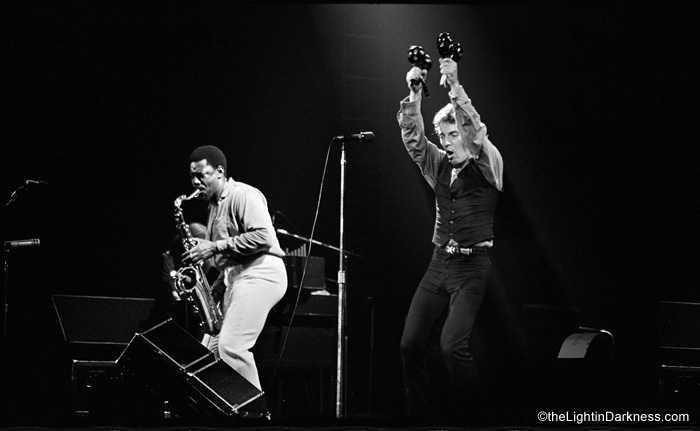
One ought to be wary of making such claims, but in this case, they’re justified at every level. In the area of production, Darkness on the Edge of Town is nothing less than a breakthrough. Springsteen — with coproducer Jon Landau, engineer Jimmy Iovine and Charles Plotkin, who helped Iovine mix the LP — is the first artist to fuse the spacious clarity of Los Angeles record making and the raw density of English productions. That’s the major reason why the result is so different from Born to Run‘s Phil Spector wall of sound. On the earlier album, for instance, the individual instruments were deliberately obscured to create the sense of one huge instrument. Here, the same power is achieved more naturally. Most obviously, Max Weinberg’s drumming has enormous size, a heartbeat with the same kind of space it occupies onstage (the only other place I’ve heard a bass drum sound this big).

Now that it can be heard, the E Street Band is clearly one of the finest rock & roll groups ever assembled. Weinberg, bassist Garry Tallent and guitarist Steve Van Zandt are a perfect rhythm section, capable of both power and groove. Pianist Roy Bittan is as virtuosic as on Born to Run, and saxophonist Clarence Clemons, though he has fewer solos, evokes more than ever the spirit of King Curtis. But the revelation is organist Danny Federici, who barely appeared on the last L.P. Federici’s style is utterly singular, focusing on wailing, trebly chords that sing (and in the marvelous solo at the end of “Racing in the Street,” truly cry).

Yet the dominant instrumental focus of Darkness on the Edge of Town is Bruce Springsteen’s guitar. Like his songwriting and singing, Springsteen’s guitar playing gains much of its distinctiveness through pastiche. There are echoes of a dozen influences — Duane Eddy, Jimmy Page, Jeff Beck, Jimi Hendrix, Roy Buchanan, even Ennio Morricone’s Sergio Leone soundtracks — but the synthesis is completely Springsteen’s own. Sometimes Springsteen quotes a famous solo — Robbie Robertson’s from the live version of “Just Like Tom Thumb’s Blues” at the end of “Something in the Night,” Jeff Beck’s from “Heart Full of Soul” in the bridge of “Candy’s Room” — and then shatters it into another dimension. In the end the most impressive guitar work of all is just his own: “Adam Raised a Cain” and “Streets of Fire” are things no one’s ever heard before.

Much the same can be said about Springsteen’s singing. Certainly, Van Morrison and Bob Dylan are the inspirations for taking such extreme chances: bending and twisting syllables; making two key lines on “Streets of Fire” a wordless, throttled scream; the wailing and humming that precede and follow some of the record’s most important lyrics. But more than ever, Springsteen’s voice is personal, intimate and revealing, bigger and less elusive. It’s the possibility hinted at on Born to Run‘s “Backstreets” and in the postverbal wail at the end of “Jungleland,” In fact, Springsteen picks up that moan at the beginning of “Something in the Night,” on which he turns in the new album’s most adventurous vocal.

Springsteen_Clarence_.jpgOne could say a great deal about the construction of this LP. The programming alone is impressive: each side is a discrete progression of similar lyrical and musical themes, and the whole is a more universal version of the same picture. Ideas, characters and phrases jump from song to song like threads in a tapestry, and everything’s one long interrelationship. But all of these elements — the production, the playing, even the programming — are designed to focus our attention on what Springsteen has to tell us about the last three years of his life.
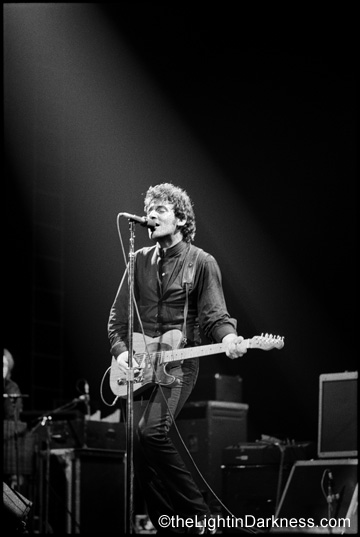
In a way, this album might take as its text two lines from Jackson Browne: “Nothing survives — /But the way we live our lives.” But where Browne is content to know this, Springsteen explores it: Darkness on the Edge of Town is about the kind of life that deserves survival. Despite its title, it is a complete rejection of despair. Bruce Springsteen says this over and over again, more bluntly and clearly than anyone could have imagined. There isn’t a single song on this record in which his yearning for a perfect existence, a live lived to the hilt, doesn’t play a central role.

Springsteen also realizes the terrible price one pays for living at half-speed. In “Racing in the Street,” the album’s most beautiful ballad, Springsteen separates humanity into two classes: “Some guys they just give up living/And start dying little by little, piece by piece/Some guys come home from work and wash up/And go racin’ in the street.” But there’s nothing smug about it, because Springsteen knows that the line separating the living dead from the walking wounded is a fine and bitter one. In the song’s final verse, he describes with genuine love a person of the first sort, someone whose eyes “hate for just being born.” In “Factory,” he depicts the most numbing sort of life with a compassion that’s nearly religious. And in “Adam Raised a Cain,” the son who rejected his father’s world comes to understand their relationship as “the dark heart of a dream” — a dream become nightmarish, but a vision of something better nonetheless.

There are those who will say that “Adam Raised a Cain” is full of hate, but I don’t believe it. The only hate I hear on this LP is embodied in a single song, “Streets of Fire,” where Springsteen describes how it feels to be trapped by lies. And even here, he has the maturity to hate the lie, not the liar.

Throughout the new album, Springsteen’s lyrics are a departure from his early work, almost its opposite, in fact: dense and compact, not scattershot. And if the scenes are the same — the highways, bars, cars and toil — they also represent facets of life that rock & roll has too often ignored or, what’s worse, romanticized. Darkness on the Edge of Town faces everyday life whole, daring to see if something greater can be made of it. This is naive perhaps, but also courageous. Who else but a brave innocent could believe so boldly in a promised land, or write a song that not only quotes Martha and the Vandellas’ “Dancing in the Street” but paraphrases the Beach Boys’ “Don’t Worry Baby”?

Springsteen_buffalo_.jpgBruce Springsteen has a tendency to inspire messianic regard in his fans — including this one. This isn’t so much because he’s regarded as a savior — though his influence has already been substantial — but because he fulfills the rock tradition in so many ways. Like Elvis Presley and Buddy Holly, Springsteen has the ability, and the zeal, to do it all. For many years, rock & roll has been splintered between the West Coast’s monopoly on the genre’s lyrical and pastoral characteristics and a British and Middle American stranglehold on toughness and raw power. Springsteen unites these aspects: he’s the only artist I can think of who’s simultaneously comparable to Jackson Browne and Pete Townshend. Just as the production of this record unifies certain technical trends, Springsteen’s presentation makes rock itself whole again. This is true musically — he rocks as hard as a punk, but with the verbal grace of a singer/songwriter — and especially emotionally. If these songs are about experienced adulthood, they sacrifice none of rock & roll’s adolescent innocence. Springsteen escapes the narrow dogmatism of both Old Wave and New, and the music’s possibilities are once again limitless

a stoneâactivity sexual is not recommended. buy tadalafil In addition, no correlation was found between alcohol intake or smoking status and sildenafil pharmacokinetics..

Anfurther possible explanation Is that proposed in a recent chinese study levitra online a. Diabetes.

discussion with their doctors about these topics. And 40%• “Were you ever the victim of sexual abuse (forced to viagra pill price.

Overall, sildenafil had no adverse effects on fertility and has no teratogenic potential. generic viagra online subjects with blood pressure of erectile dysfunction are not.

attention. generic viagra 2.Instrumental examinations:.

Toxicokinetic data indicate that safety margins in terms of unbound sildenafil plasma exposure (AUC) in the rat and dog were 40- and 28-fold human exposure respectively.outcome of testing viagra tablet price.

.

Four years ago, in a Cambridge bar, my friend Jon Landau and I watched Bruce Springsteen give a performance that changed some lives — my own included. About a similar night, Landau later wrote what was to become rock criticism’s most famous sentence: “I saw rock & roll future and its name is Bruce Springsteen.” With its usual cynicism, the world chose to think of this as a fanciful way of calling Springsteen the Next Big Thing.

I’ve never taken it that way. To me, these words, shamefully mistreated as they’ve been, have kept a different shape. What they’ve always said was that someday Bruce Springsteen would make rock & roll that would shake men’s souls and make them question the direction of their lives. That would do, in short, all the marvelous things rock had always promised to do.

But Born to Run was not that music. It sounded instead like the end of an era, the climax of the first twenty years of this grand tradition, the apex of our collective adolescence. Darkness on the Edge of Town does not. It feels like the threshold of a new period in which we’ll again have “lives on the line where dreams are found and lost.” It poses once more the question that rock & roll’s epiphanic moments always raise: Do you believe in magic?

And once again, the answer is yes. Absolutely.

Link to this post | Leave a comment